What Are Data Agents for BI? How They Work (2026)
Data agents for BI are purpose-built AI components that handle specific analytics tasks: querying databases, building dashboards, detecting anomalies, and delivering reports, without requiring a human to trigger each step. Unlike AI assistants that respond only when asked, data agents execute multi-step workflows on their own and retain context across interactions.
Quick Summary (TL;DR)
Data agents are specialized AI components assigned to specific analytics jobs: one agent queries, another builds dashboards, another detects anomalies.
The key difference from an AI assistant: an assistant waits to be asked; an agent acts, completes a workflow, and delivers a result without prompting.
Data agents that operate inside the data layer (with access to schemas and query engines) produce more accurate outputs than agents layered on top of existing dashboards.
Most BI platforms offer AI assistants or copilots, not true data agents. The distinction matters when you need analytics that runs without a data team managing every step.
Common agent types include query agents, dashboard agents, anomaly detection agents, report delivery agents, and document AI agents.
What Are Data Agents, Exactly?
A data agent is an AI component with a defined scope of work inside an analytics platform. It has access to the data layer, knows the schema and field types, and can take action: write a query, execute it, format the result, and deliver it, without a human completing each step. The "agent" framing matters because it describes autonomous operation, not assisted operation.
The clearest contrast is with an AI copilot or assistant. A copilot answers when you ask. It can help you write a query, summarize a chart, or suggest a visualization. But it stops when you stop. A data agent continues. It monitors a metric, detects a change, runs the relevant query, builds the output, and sends it to you before you think to ask. Understanding how data agents differ from traditional BI makes the distinction clearer: traditional BI requires a human at every step. Agents don't.
The other critical distinction is where the agent lives in the stack. An agent with access only to pre-built dashboards can summarize what it sees. An agent with access to the raw data layer (schemas, indexes, field types, query engine) can go find what you need, construct the query against actual data structure, and return a precise result. The second type is architecturally different from the first, not just more powerful.
How Data Agents Work Inside a BI Platform
When a user asks a question or a scheduled trigger fires, a data agent begins a sequence: it identifies the relevant data source, maps the question to the schema, writes the appropriate query, executes it, and formats the output. This happens in one pass, not through multiple back-and-forth tool calls. The agent retains context from prior interactions so that follow-up questions ("break that down by region") don't require restating the original context.
The agent's accuracy depends on where in the stack it operates. Agents that sit at the data layer have direct access to schema metadata, field names, data types, and relationships. They don't guess. Agents layered on top of dashboards or semantic models work with pre-processed data, which limits what they can access and how precisely they can answer. Both exist in the market, and they behave differently under real workloads.
Proactive delivery is a defining capability of mature data agents. Rather than waiting for a query, the agent monitors metrics, detects anomalies, and pushes relevant findings to the right person at the right time. A dashboard agent can build and modify dashboards based on changes in the underlying data. A widget agent generates individual chart components from a text description. Neither requires a human to open a BI tool and start from scratch.
Types of Data Agents
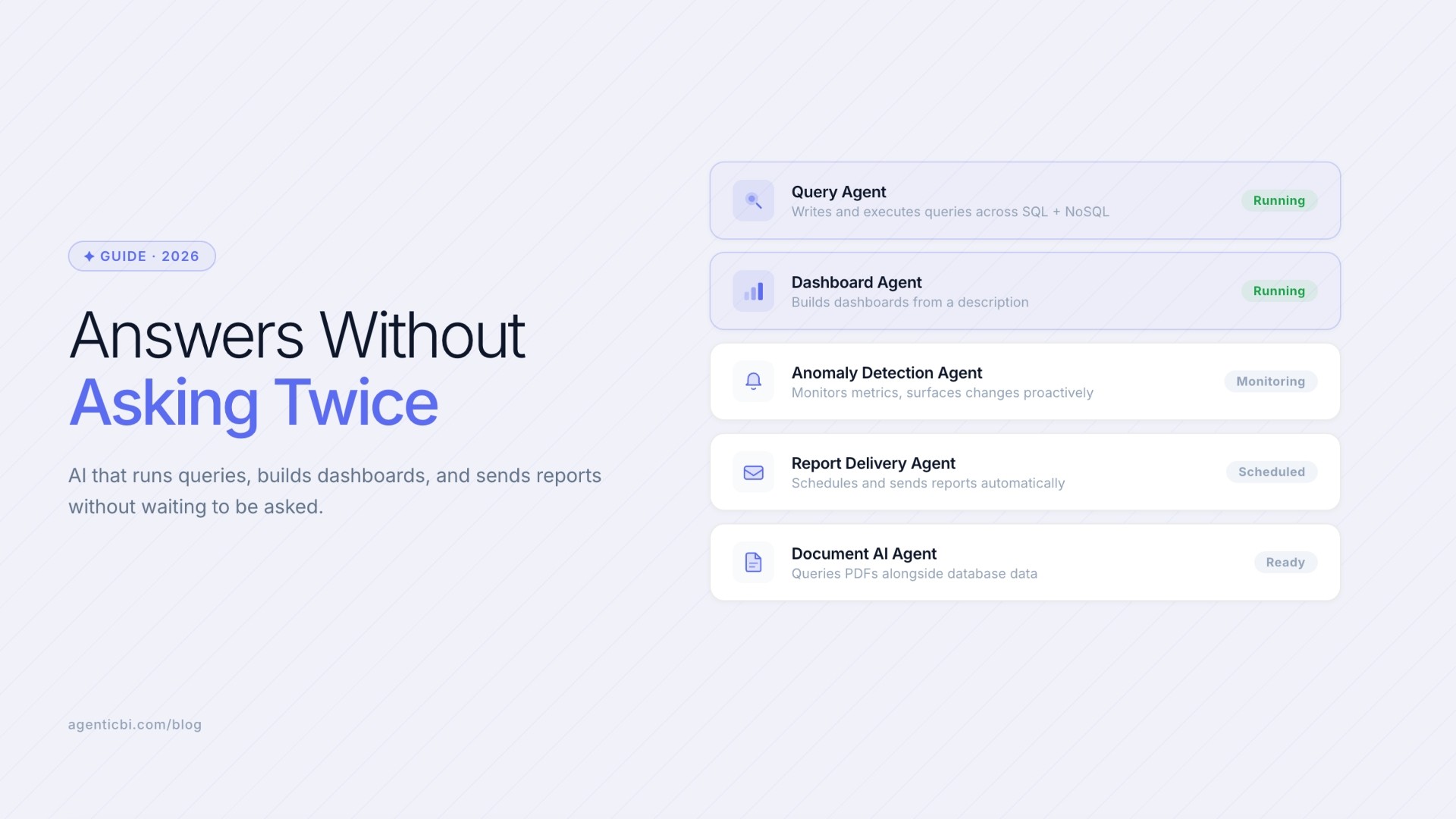
Query Agent
Translates natural language questions into database queries, executes them against the source, and returns structured results. Works across SQL, NoSQL, and REST API sources on platforms that support native multi-source connectivity. The query agent is the foundational layer most other agents depend on.
Dashboard Agent
Builds, modifies, and updates dashboards from natural language instructions. "Show me a dashboard with last month's revenue by region, filtered to accounts over $10K" generates the full layout without manual widget configuration. Updates existing dashboards when the underlying query or data model changes.
Anomaly Detection Agent
Monitors metrics continuously and surfaces statistically significant changes. Identifies whether a drop in a KPI is noise or a real signal, cross-references contributing factors across data sources, and alerts the right stakeholder with context. Operates on a schedule without requiring manual review.
Report Delivery Agent
Generates and distributes scheduled reports to specified recipients in the right format: email, Slack, embedded in a product. Can personalize content by recipient based on role or segment. Runs on a schedule without manual export or formatting.
Document AI Agent
Queries documents (PDFs, Word, Excel, CSV) alongside database data. Extracts structured information from unstructured files and joins it with live query results. Useful for teams that need to analyze contracts, invoices, or reports alongside operational data from a database.
Want data agents handling your analytics? Start free at AgenticBI.com. No data team required.
Data Agents vs AI Assistants vs Traditional BI
Capability | Traditional BI | AI Assistant / Copilot | Data Agent |
|---|---|---|---|
Initiates analysis | Human always | Human always | Agent or human |
Multi-step workflows | Manual, step by step | Assisted, human-led | Autonomous end-to-end |
Proactive delivery | Scheduled reports only | None | Yes, event or schedule driven |
Context retention | None | Session only | Persistent across interactions |
Data team required | Yes, for every new query | Reduced, not eliminated | No, for most operational tasks |
NoSQL + API native | Rarely | Rarely | Depends on platform |
What to Look for When Evaluating Data Agent Platforms
The first question is where the agents operate in the stack. Agents that query source data directly produce different results than agents that work on pre-aggregated dashboard data or semantic models. If your data is in MongoDB, Elasticsearch, or a REST API, verify native connectivity before evaluating anything else. Most platforms require ETL into a SQL warehouse before AI can touch the data.
The second question is deployment. Organizations with HIPAA requirements, financial data regulations, or strict data residency rules need agents that run inside their own environment. Most platforms are cloud-only. Private AI deployment, where no data is routed through external LLMs, is available on a smaller set of platforms and is a non-negotiable for regulated industries.
The third question is whether agents are purpose-built or general. A single AI assistant handling all tasks is different from a platform with a dedicated query agent, a dashboard agent, an anomaly detection agent, and a document AI agent: each tuned for its specific job. Specialized agents generally produce more consistent results on complex, multi-source tasks. For a broader view of platforms that use data agents, the architecture differences between options become clear when you evaluate against a real data stack rather than a demo environment.
Want data agents handling your analytics? Start free here. No data team required.
Frequently Asked Questions
What is the difference between a data agent and an AI assistant?
An AI assistant responds when you ask it something. A data agent acts on its own: it monitors data, executes multi-step workflows, and delivers results without a human initiating each step. Assistants are reactive; agents are proactive and autonomous.
Do data agents require a data team to manage?
Not for most operational tasks. Data agents handle query writing, dashboard creation, anomaly detection, and report delivery autonomously. A data team may still be valuable for initial setup, data governance, and complex modeling, but the day-to-day analytics burden is removed from engineering queues.
Can data agents work with NoSQL databases?
It depends on the platform. Most BI tools require data to be moved into a SQL warehouse before agents can query it. Platforms with native NoSQL connectivity allow agents to query MongoDB, Elasticsearch, Cassandra, and similar sources directly, without ETL. Verifying this before evaluating is important for teams on non-SQL data stacks.
How are data agents different from agentic BI?
"Agentic BI" describes the broader category of analytics platforms that use agents. A "data agent" is the specific component that performs a task within that category. Agentic BI is the platform architecture; data agents are the individual workers inside it.
What tasks can a data agent handle without human input?
Query execution, dashboard creation and updates, anomaly detection and alerting, scheduled report generation and delivery, and document analysis. The specific capabilities depend on which agents the platform includes and how deeply they're integrated with the data layer.
Do data agents work across multiple data sources at once?
On platforms with cross-source joining, yes. An agent can query MongoDB and a REST API in the same workflow, join the results, and return a unified output. This requires native multi-source support. It's not available on platforms that require all data to be consolidated into a single warehouse first.
Related reading:
Try AgenticBI
The AI data analyst for teams without a data team
Your numbers live in your database, your tools, and a dozen spreadsheet tabs, each telling a slightly different story. AgenticBI connects to all of them, runs the query, and hands back one answer. You ask in your own words. Agents do the analysis. And it can run on its own AI, so your data never leaves for a third party.
What you can do with AgenticBI:
Free to start. Your data can stay yours, nothing goes to OpenAI or any outside model.
Learn more
Discover more from the latest posts.


