Why Business Intelligence Requires Specialized Agents, Not Generic AI Bots
TL;DR
Generic AI agents lack the domain expertise needed for sophisticated business intelligence, they're generalists in a field requiring specialists
BI requires deep understanding of business context, industry dynamics, and metric relationships that generic agents cannot develop
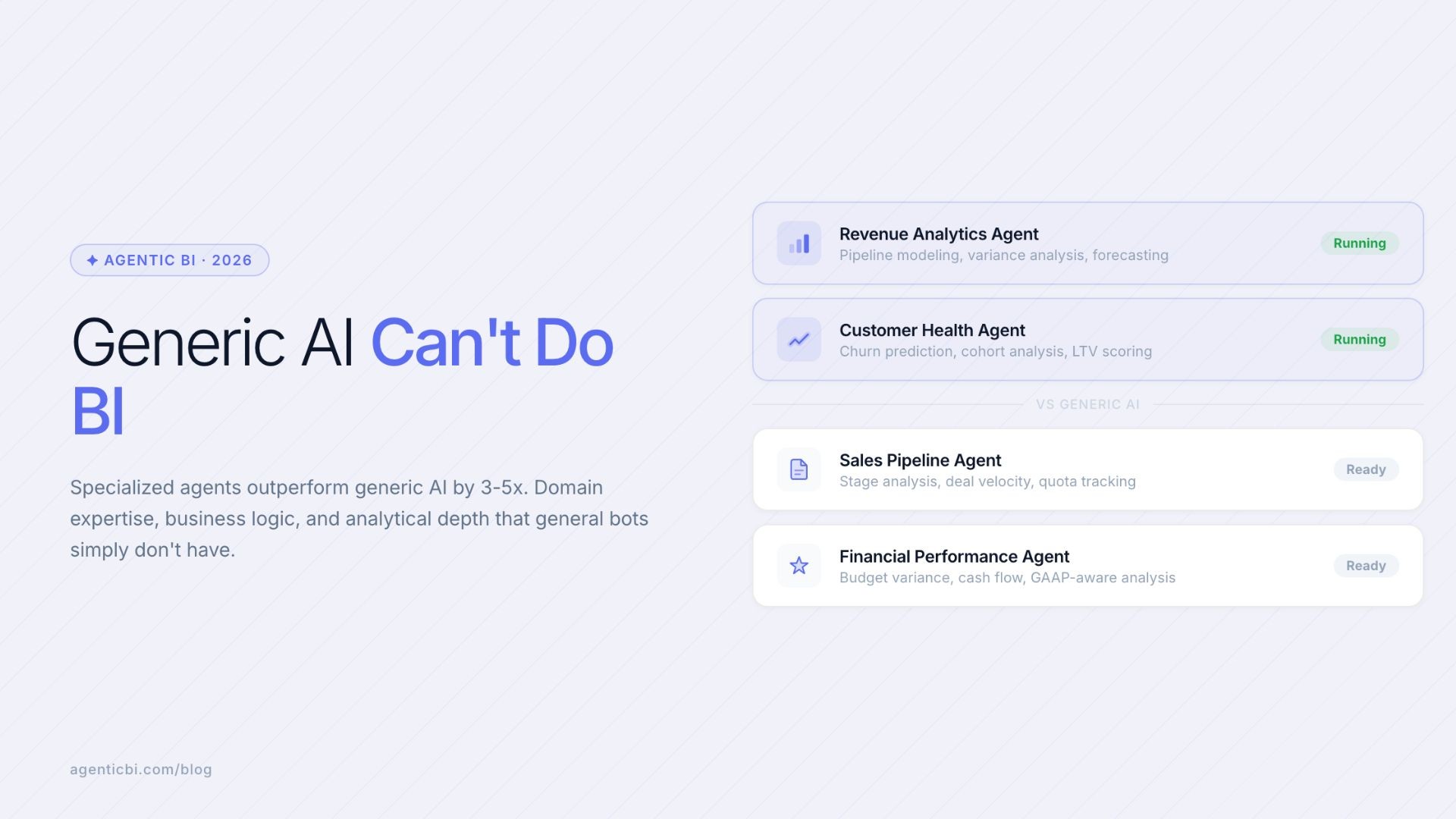
Specialized agents outperform generic AI by 3-5x in accuracy and relevance because they embed business logic and analytical expertise
While generic agents can handle simple queries, complex analytical workflows require agents trained specifically for business intelligence
The future of Agentic BI lies in purpose-built agents that combine AI capabilities with business analytical expertise
The Generic AI Agent Limitations
The rapid advancement of large language models has led many organizations to believe that general-purpose AI agents can handle business intelligence tasks. While impressive for broad conversational AI, generic agents face fundamental limitations when applied to analytical business intelligence.
What Generic AI Agents Struggle With
Business Context Understanding
Generic AI agents operate without the contextual intelligence required to interpret real business environments. They don’t understand the why behind the data, only the what.
That creates major gaps in analysis:
No understanding of industry-specific metrics or their relationships
Metrics like ARR vs MRR, AHT vs FCR, DAU/WAU ratios, inventory turns, or gross margin drivers vary dramatically by sector.
A generic agent can calculate numbers but can’t interpret them relative to industry norms or operational constraints.
Example: A spike in returns may be normal in e-commerce during holiday peaks but alarming in a B2B SaaS renewal cycle.
Cannot distinguish normal fluctuations from real business risks
Businesses experience cyclical patterns, seasonal spikes, and quarter-end behaviors. Generic agents treat all variance equally, often flagging non-issues or missing early warning signals.
No awareness of market dynamics or business cycles
A generic agent cannot contextualize data in terms of:
Competitive shifts
Macro trends
Industry regulations
Seasonal buying patterns
Demand volatility
This leads to recommendations that sound plausible but have no connection to business reality.
Cannot interpret the business significance behind statistical patterns
A generic agent may identify a correlation, but it cannot answer:
Does this correlation matter?
Is it expected?
What is the business impact?
Does this require action?
Without context, insights remain shallow and often misleading.
Analytical Sophistication
Even when data is available, generic AI agents are not equipped to perform the advanced analytical workflows required in BI.
Limited to surface-level data exploration
Most generic models can describe trends or compute summaries, but they cannot:
Build robust analytical narratives
Run scenario analysis
Apply statistical rigor
Validate assumptions
Incapable of multi-step analytical workflows
True analytics requires sequences of tasks:
Identify the dataset
Apply transformations
Run investigations
Validate significance
Generate insights
Recommend actions
Generic agents collapse at steps 3 to 6. BI agents must be able to chain steps into a coherent workflow.
Struggle with advanced analytic techniques
Generic agents cannot reliably perform:
Cohort analysis
Churn prediction modeling
Customer lifetime value (LTV) estimation
Forecasting with seasonality
Root cause analysis
Segmentation and clustering
A/B test interpretation
These require deep knowledge of when and how to apply specific analytical approaches.
No sense of analytical appropriateness
A generic agent cannot determine if a question requires:
Regression
Time series decomposition
Funnel analysis
Hypothesis testing
Anomaly detection
Business Process Integration
Even if an agent generates correct insights, it must understand business processes to make those insights actionable. Generic agents do not.
Cannot translate findings into actionable business steps
Generic AI may say, “Customer churn increased,” but cannot recommend:
Actions CS teams can take
Processes to adjust
Segments to target
Interventions that drive outcomes
No understanding of organizational capabilities or constraints
A recommendation like “hire more staff” is meaningless without understanding:
Team bandwidth
Budget constraints
Existing workflows
SLA limits
Operational bottlenecks
Specialized agents understand what’s realistic.
Unable to prioritize insights based on business impact
Not all issues are equal and without prioritization, insights become noise.Generic AI can’t rank:
Revenue-critical issues
Compliance risks
Customer churn signals
Mission-critical operations
No awareness of stakeholder roles or communication patterns
Specialized BI agents know:
What executives care about
What analysts need
What frontline teams act on
How different teams consume insights
Generic agents lack this, leading to mismatched or irrelevant outputs.
Real-World Example: Customer Churn Analysis
User: "Why is our customer churn increasing?"
Generic AI Agent Response:
Generic Agent: "Your churn rate has increased from 12% to 18% over the last quarter. This could be due to various factors like pricing, competition, product issues, or seasonal patterns. You should investigate customer feedback and compare with industry benchmarks."
Specialized BI Agent Response:
Customer Health Agent: "Enterprise customer churn increased to 23% (vs 15% historical average) driven by Q2 cohort showing 40% churn rate. Root cause analysis indicates onboarding completion delay (average 45 days vs target 30 days) correlates with 3.2x higher churn probability. Recommend immediate deployment of customer success intervention to 14 at-risk enterprise accounts with onboarding delays >35 days. Similar intervention in Q4 2023 reduced churn by 35%."
What Makes BI Different from Generic AI Tasks
Business Intelligence Requires Specialized Knowledge
Domain Expertise: BI agents need deep understanding of:
Industry-specific metrics and their normal ranges
Business process flows and their analytical implications
Seasonal patterns and cyclical variations
Competitive landscape and market dynamics
Regulatory requirements and compliance considerations
Analytical Methodology: BI requires sophisticated analytical capabilities:
Statistical significance testing and confidence intervals
Time series analysis and forecasting techniques
Cohort analysis and customer behavior modeling
A/B testing design and results interpretation
Predictive modeling and machine learning application
Business Context: Effective BI demands business understanding:
Organizational goals and strategic priorities
Resource constraints and implementation capabilities
Stakeholder roles and decision-making authority
Risk tolerance and business rule frameworks
Communication preferences and reporting requirements
Generic AI vs Specialized BI: Core Differences
Aspect | Generic AI Agent | Specialized BI Agent |
|---|---|---|
Knowledge Scope | Broad but shallow | Deep domain expertise |
Analytical Methods | Basic statistical operations | Advanced analytical techniques |
Business Context | Generic business knowledge | Industry-specific understanding |
Insight Quality | Surface-level observations | Actionable business intelligence |
Learning Focus | General conversation improvement | Business outcome optimization |
Integration | Limited business process awareness | Deep workflow integration |
Domain Expertise vs General Intelligence
The Specialist Advantage
Human business intelligence follows the same pattern, successful analysts specialize in domains like:
Financial Analytics: Understanding of accounting principles, financial metrics, and regulatory requirements
Marketing Analytics: Knowledge of attribution models, campaign optimization, and customer behavior
Operations Analytics: Expertise in supply chain, logistics, and process optimization
Sales Analytics: Understanding of sales processes, pipeline management, and forecasting
A financial analyst can spot revenue recognition issues that a marketing analyst might miss, and vice versa for customer acquisition cost optimization.
Specialized Agent Knowledge Embedding
Financial Analytics Agent:
Built-in Knowledge:
GAAP/IFRS accounting standards
Financial ratio analysis techniques
Budget variance investigation methodologies
Cash flow forecasting models
Risk assessment frameworks
Analytical Capabilities:
Automated variance analysis with business context
Predictive financial modeling
Scenario planning and sensitivity analysis
Regulatory compliance monitoring
Cross-functional cost allocation
Customer Analytics Agent:
Built-in Knowledge:
Customer lifecycle stage definitions
Churn prediction risk factors
Segmentation methodologies
Lifetime value calculation models
Retention strategy frameworks
Analytical Capabilities:
Cohort analysis automation
Predictive churn modeling
Customer health scoring
Segmentation optimization
Retention campaign effectiveness tracking
Specialized Agent Architecture
Core Components of BI-Specialized Agents
Domain Knowledge Base:
Industry-specific metrics and definitions
Business process understanding and workflows
Historical pattern recognition and seasonal adjustments
Competitive intelligence and market context
Regulatory and compliance requirements
Analytical Engine:
Statistical methods appropriate for business data
Machine learning models trained on business outcomes
Time series analysis and forecasting capabilities
Experimental design and A/B testing frameworks
Root cause analysis and investigation methodologies
Business Logic Layer:
Stakeholder communication protocols
Escalation procedures and alert prioritization
Action recommendation frameworks
Resource allocation and constraint understanding
Performance measurement and optimization metrics
Learning and Adaptation:
Business outcome tracking and feedback integration
Model performance optimization based on decision results
Continuous learning from analytical successes and failures
Adaptation to changing business conditions and priorities
Agent Specialization Framework
As organizations mature in their use of Agentic BI, they begin to deploy specialized agents: each trained to handle the analytical needs of a specific business function, department, or industry. Think of it as building an internal workforce of digital analysts, each with deep domain expertise.
These agents fall into three tiers:
Tier 1: Core Business Functions
Revenue Analytics Agent
Customer Analytics Agent
Financial Performance Agent
Operational Efficiency Agent
Tier 2: Departmental Specialists
Sales Pipeline Agent
Marketing Attribution Agent
Supply Chain Optimization Agent
Human Resources Analytics Agent
Tier 3: Industry-Specific Agents
E-commerce Conversion Agent
SaaS Metrics Agent
Manufacturing Quality Agent
Healthcare Outcomes Agent
Real-World Implementation Results
Case Study: Mid-Market SaaS Company
Generic AI Implementation (6 months):
23% of generated insights acted upon by business stakeholders
3.2 hour average time from insight generation to stakeholder review
15% false positive rate for critical alerts
Limited adoption due to stakeholder skepticism about relevance
Specialized Agent Implementation (6 months):
78% of generated insights acted upon by business stakeholders
12 minutes average time from insight generation to stakeholder notification
3% false positive rate for critical alerts
High stakeholder satisfaction and expanding usage across departments
Building Specialized BI Agents
Developing specialized BI agents isn’t just about giving an LLM access to data, it’s about embedding deep business expertise, analytical frameworks, and organizational context into the agent’s intelligence.
This requires a structured, three-phase development framework that mirrors how real human analysts are trained: understanding the business, mastering analytical methods, and integrating into workflows.
Development Framework
Phase 1: Domain Knowledge Engineering
Map business processes and analytical requirements
Identify key metrics, relationships, and success criteria
Define business rules, constraints, and decision frameworks
Catalog analytical methods and their appropriate use cases
Phase 2: Analytical Capability Development
Implement statistical and machine learning methods
Build business-specific data models and transformations
Create automated investigation and root cause analysis workflows
Develop predictive models trained on business outcomes
Phase 3: Business Integration
Define stakeholder communication protocols and preferences
Implement action recommendation and escalation procedures
Create performance measurement and optimization frameworks
Build feedback loops for continuous learning and improvement
Key Success Factors
Business Expertise Partnership: Collaborate with domain experts to embed business knowledge and analytical best practices
Iterative Refinement: Continuously improve agent performance based on business outcome tracking and stakeholder feedback
Context Preservation: Maintain business context and institutional knowledge across agent interactions
Performance Optimization: Focus on business impact metrics rather than general AI performance measures
The Specialization Advantage
Competitive Benefits of Specialized Agents
Analytical Depth: Specialized agents apply sophisticated analytical methods appropriate for specific business contexts rather than generic statistical operations
Business Relevance: Insights include actionable recommendations based on deep understanding of organizational capabilities and constraints
Stakeholder Trust: Business users develop confidence in agent recommendations when they consistently demonstrate business understanding and analytical sophistication
Organizational Learning: Specialized agents capture and operationalize institutional knowledge, making expert analytical capabilities available across the organization
Future Development Path
Industry-Specific Enhancement: Agents will develop increasing specialization in industry verticals (healthcare, financial services, manufacturing, retail)
Cross-Functional Coordination: Specialized agents will collaborate on complex business problems requiring multiple domain expertise
Adaptive Specialization: Agents will automatically develop new specializations based on organizational needs and analytical patterns
Expert-Level Performance: Specialized agents will eventually match or exceed human expert analytical capabilities within their domains
Generic agents can’t deliver BI insights. Specialized agents can. Knowi is bringing them to life. Join the waitlist.
Learn More About Agent Specialization:
This content is powered by Knowi, building the next generation of specialized business intelligence agents.Visit ww.knowi.com.
Frequently Asked Questions
1. Why can’t generic AI agents deliver reliable business intelligence?
Generic AI agents lack domain knowledge, business context, and analytical frameworks. They can summarize data but cannot interpret industry-specific metrics, identify meaningful patterns, or execute multi-step analytical workflows required for BI.
2. What makes BI different from standard AI tasks?
BI requires a deep understanding of metric relationships, industry norms, business processes, and organizational priorities. Unlike generic AI, BI involves statistical rigor, forecasting, cohort analysis, and stakeholder-specific insights that demand specialized analytical expertise.
3. What are specialized BI agents?
Specialized BI agents are AI systems trained on domain-specific business knowledge, analytical methods, KPIs, workflows, and decision frameworks. They function like digital analysts—providing accurate, contextual, and actionable business recommendations.
4. How do specialized BI agents outperform generic AI agents?
Specialized agents outperform generic models by 3-5x because they:
Understand domain-specific metrics
Apply the right analytical methods
Interpret business cycles and trends
Produce actionable recommendations
Prioritize insights based on business impact
Generic AI can’t do any of these reliably.
5. Can generic AI agents handle complex analytical workflows?
No. Generic agents struggle with multi-step workflows like root-cause analysis, cohort exploration, forecasting, segmentation, or anomaly detection. Specialized BI agents are designed to chain these steps logically and autonomously.
6. Why is domain expertise essential for BI agents?
BI insights require understanding why metrics shift, what’s normal, and what actions will improve outcomes. Domain expertise ensures agents interpret data correctly, distinguish anomalies from expected trends, and recommend context-aware business actions.
7. What kinds of specialized agents do organizations typically deploy?
Companies deploy agents across three tiers:
Core business function agents: Revenue, Customer Health, Financial Performance
Department specialists: Sales Pipeline, Marketing Attribution, HR Analytics
Industry-specific agents: SaaS Metrics, E-commerce Conversion, Manufacturing Quality, Healthcare Outcomes
8. How do specialized BI agents integrate into workflows?
They plug into existing tools—Slack, email, CRMs, dashboards, workflows and deliver insights where teams work. They also trigger actions (alerts, recommendations, workflows) based on business rules and real-time data.
9. What does developing a specialized BI agent involve?
It requires a structured framework:
Domain engineering: Business rules, KPIs, decision logic
Analytical intelligence: ML models, statistical workflows, data transformations
Operational integration: Communication protocols, action automation, feedback loops
This mirrors how human analysts are trained.
10. What business outcomes improve with specialized BI agents?
Organizations see:
Faster decision-making
Higher insight adoption
More accurate predictions
Reduced manual analysis
Stronger stakeholder trust
Better cross-team alignment
Specialized agents turn data into action, not just dashboards.
11. Will specialized agents replace analysts?
No. They augment analysts by automating routine analysis, surfacing insights, performing investigations, and scaling analytical expertise across the organization. Analysts focus on strategy while agents handle execution.
12. How is Knowi building specialized BI agents?
Knowi is developing a domain-specific digital analyst workforce, agents built with business context, analytics expertise, and workflow intelligence. These agents deliver accurate, actionable BI insights far beyond what generic AI can do.
Try AgenticBI
The AI data analyst for teams without a data team
Your numbers live in your database, your tools, and a dozen spreadsheet tabs, each telling a slightly different story. AgenticBI connects to all of them, runs the query, and hands back one answer. You ask in your own words. Agents do the analysis. And it can run on its own AI, so your data never leaves for a third party.
What you can do with AgenticBI:
Free to start. Your data can stay yours, nothing goes to OpenAI or any outside model.
Learn more
Discover more from the latest posts.


