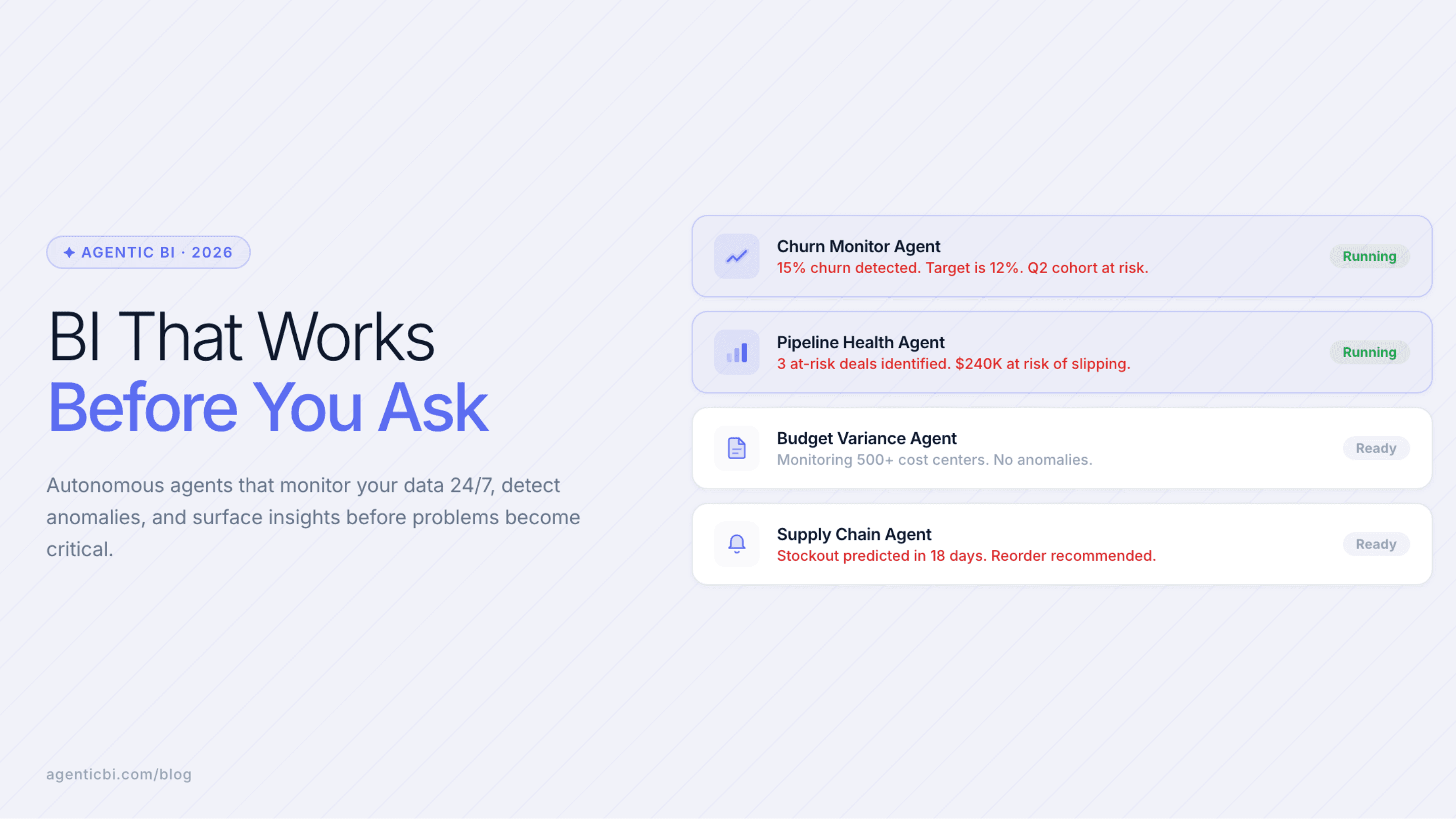
What Is Agentic BI? (And Why Conversational BI Is Not Enough)
TL;DR
Agentic BI represents the next evolution of business intelligence, where autonomous agents proactively analyze data, identify insights, and take action without human intervention
Unlike conversational BI that requires users to ask the right questions, Agentic BI anticipates needs and delivers insights automatically
Built on semantic understanding of business context, these agents operate as an "analytics workforce" handling routine analysis tasks
While conversational BI breaks at scale due to query complexity and context limitations, Agentic BI scales through specialized, domain-aware agents
This shift from reactive dashboards to proactive intelligence represents the future of data-driven decision making
Table of Contents
The Limitations of Current BI Approaches
What Is Agentic BI?
Why Conversational BI Falls Short
The Agentic Difference: Proactive vs Reactive
Real-World Applications
The Technology Behind Agentic BI
Getting Started with Agentic BI
Frequently Asked Questions
The Limitations of Current BI Approaches
Traditional business intelligence has followed the same pattern for decades: data goes into dashboards, humans look at dashboards, humans interpret what they see. This worked when data was simpler and business moved slower. But in 2026, this approach is fundamentally broken.
The Problem with Static Dashboards:
80% of dashboards are never viewed after the first week
Average executive spends 2.5 hours daily hunting for insights
Critical anomalies go unnoticed until it's too late
Every new question requires building new reports
The Problem with Conversational BI: While "chat with your data" seemed like the solution, it introduced new problems:
Users must know what questions to ask
Complex queries require SQL-like precision in natural language
Context is lost between conversations
No proactive monitoring or alerting
Most organizations have tried conversational BI tools only to find their teams still spending hours manually exploring data, missing critical insights, and struggling to scale their analytics efforts.
What Is Agentic BI?
Agentic BI is business intelligence powered by autonomous agents that proactively analyze data, identify insights, and take action without human intervention.
Think of Agentic BI as hiring an analytics workforce that never sleeps. These agents:
Monitor continuously: Track KPIs, detect anomalies, identify trends 24/7
Analyze autonomously: Apply statistical methods, machine learning, and business rules automatically
Communicate proactively: Alert stakeholders with context and recommendations
Take action: Execute predefined responses like updating forecasts or triggering workflows
Learn constantly: Improve performance based on feedback and outcomes
It's the same idea behind the AI data analyst: software that does the analysis for you, not just chats about it.
Core Characteristics of Agentic BI
Autonomous Operation: Agents work independently without constant human guidance
Goal-Oriented: Each agent has specific objectives (monitor churn, track inventory, optimize campaigns)
Context-Aware: Deep understanding of business semantics, not just data structures
Proactive: Surfaces insights before problems become critical
Scalable: Handles growing data complexity without adding human resources
Why Conversational BI Falls Short
Conversational BI was supposed to democratize data analysis by letting anyone "chat with their data." In practice, it created new bottlenecks:
The Question Problem
Users don't know what they don't know. Most business users lack the context to ask sophisticated analytical questions. They'll ask "What were our sales last month?" but miss asking "Why did our customer acquisition cost spike in the northeast region?"
The Complexity Ceiling
Natural language breaks down with complex analysis. Try asking a conversational BI tool: "Show me customer cohorts with declining lifetime value where the primary driver is increased support costs, segmented by acquisition channel and weighted by strategic account value."
The Context Gap
Conversations don't maintain business context. Each query starts fresh without understanding of previous analysis, business priorities, or strategic context that humans inherently know.
The Scale Wall
Human-in-the-loop doesn't scale. As data volume and business complexity grow, the number of questions that need asking grows exponentially. Conversational BI still requires humans to drive every interaction.
The Agentic Difference: Proactive vs Reactive
Traditional/Conversational BI | Agentic BI |
|---|---|
Human asks questions | Agent identifies what to investigate |
Reactive to user queries | Proactive insight generation |
Limited by human capacity | Scales with computational resources |
Static context | Dynamic, evolving understanding |
One-time analysis | Continuous monitoring and learning |
Human drives exploration | Agent drives exploration |
Example: Customer Churn Analysis
Conversational BI Approach:
User asks: "What's our churn rate?"
Tool responds: "15% this quarter"
User asks: "Why is it high?"
Tool shows generic churn factors
User manually explores segments, timeframes, cohorts...
Agentic BI Approach:
Churn monitoring agent detects 15% rate (vs 12% target)
Agent automatically analyzes: cohorts, channels, support tickets, product usage
Agent identifies: Enterprise customers from Q2 campaign showing 23% churn due to onboarding issues
Agent recommends: Deploy retention specialist to Q2 enterprise cohort
Agent monitors outcome and refines detection model
Real-World Applications
Finance: Autonomous Budget Variance Agent
Monitors spend vs budget across 500+ cost centers
Identifies unusual variance patterns before monthly reviews
Automatically categorizes variances and flags for approval
Predicts quarter-end position and recommends reforecasting
Sales: Pipeline Health Agent
Analyzes deal progression velocity across reps and regions
Detects at-risk opportunities before they slip
Recommends optimal follow-up actions based on similar deal patterns
Automatically updates forecasts with confidence intervals
Operations: Supply Chain Optimization Agent
Monitors inventory levels, supplier performance, demand signals
Predicts stockouts 2-3 weeks before they occur
Optimizes reorder points based on seasonal patterns and lead times
Automatically adjusts procurement plans for cost efficiency
The Technology Behind Agentic BI
Agentic BI requires four foundational technologies working together:
1. Semantic Layer
Agents need deep understanding of business concepts, not just database schemas. A robust semantic layer maps raw data to business meaning: "customer_id" becomes "unique business relationship with defined lifecycle stages and value metrics."
2. Autonomous Analytics Engine
Unlike rule-based alerting, agents use adaptive algorithms that learn patterns, detect anomalies, and generate insights using statistical methods, machine learning, and business logic.
3. Goal-Oriented Architecture
Each agent operates with specific objectives and success metrics. The architecture supports agent specialization, coordination, and performance optimization.
4. Action Framework
Agents don't just analyze - they act. This requires secure, auditable mechanisms for agents to update systems, send communications, and trigger workflows.
Getting Started with Agentic BI
Step 1: Identify Agent Opportunities
Look for analytics tasks that are:
Repetitive and time-consuming
Critical but often delayed
Require consistent methodology
Have clear success criteria
Step 2: Start with Monitoring Agents
Begin with agents that monitor KPIs and detect anomalies in well-understood business processes like sales performance, customer health, or operational metrics.
Already using an AI assistant agent? See how it fits into an agentic workflow.
Step 3: Build Semantic Foundation
Invest in a semantic layer that captures business logic, definitions, and relationships. This becomes the foundation for agent intelligence.
Step 4: Implement Gradually
Deploy agents incrementally, measuring their impact on decision speed, insight quality, and resource efficiency.
Frequently Asked Questions
What is Agentic BI?
Agentic BI is business intelligence powered by autonomous agents that proactively monitor data, generate insights, and take action without waiting for human queries.
How is Agentic BI different from traditional BI?
Traditional BI is dashboard-driven and reactive. Agentic BI continuously analyzes data and surfaces insights automatically, before users know to ask.
How is Agentic BI different from conversational BI?
Conversational BI requires users to ask questions. Agentic BI identifies what matters, investigates autonomously, and delivers insights proactively.
Does Agentic BI replace dashboards?
No. Dashboards still exist, but agents handle continuous monitoring, analysis, and insight generation, reducing reliance on manual dashboard reviews.
Do organizations still need data analysts with Agentic BI?
Yes. Analysts shift from repetitive reporting to higher-value work like defining agent goals, refining business logic, and validating insights.
Is Agentic BI just automated alerts?
No. Unlike static alerts, Agentic BI uses adaptive analytics, statistics, and machine learning to detect patterns, anomalies, and trends dynamically.
Can Agentic BI take actions automatically?
Yes. With proper governance, agents can trigger workflows, update forecasts, notify stakeholders, and execute predefined actions securely.
How does Agentic BI maintain business context?
Agentic BI relies on a semantic layer that captures business definitions and relationships, allowing agents to retain context across analyses.
Is Agentic BI secure and governed?
Yes. Agentic BI platforms include role-based access, scoped agent permissions, approval workflows, and full audit trails.
Who should use Agentic BI?
Agentic BI is ideal for organizations struggling with manual analysis, missed insights, or scaling analytics across growing data complexity.
Where should teams start with Agentic BI?
Most teams begin with monitoring and anomaly-detection agents for KPIs like sales performance, customer health, or operational metrics.
What makes Knowi an Agentic BI platform?
Knowi combines semantic intelligence, autonomous analytics agents, and action frameworks to deliver proactive, scalable business intelligence.
Evaluating alternatives? See how Agentic BI compares to Power BI Copilot.
This content is powered by Knowi, the leading Agentic BI platform.
Related reading:
• What Are Data Agents for BI?
Try AgenticBI
The AI data analyst for teams without a data team
Your numbers live in your database, your tools, and a dozen spreadsheet tabs, each telling a slightly different story. AgenticBI connects to all of them, runs the query, and hands back one answer. You ask in your own words. Agents do the analysis. And it can run on its own AI, so your data never leaves for a third party.
What you can do with AgenticBI:
Free to start. Your data can stay yours, nothing goes to OpenAI or any outside model.
Learn more
Discover more from the latest posts.


