The End of Dashboards: How Agentic AI Is Revolutionizing Business Intelligence
How Agentic AI in analytics is revolutionizing the BI landscape. Based on an interview with Jay Gopalakrishnan, CEO-Founder, Knowi.
The Dashboard Paradox
Here's an uncomfortable truth about today’s business intelligence: We've built sophisticated dashboards that most people either can't understand or don't know how to use effectively.
Think about your organization's BI adoption:
How many dashboards exist that no one regularly checks?
How often do users download data to Excel because the dashboard doesn't answer their specific question?
How many times has someone asked "Can you create a report that shows..." for something that should be simple?
The problem isn't the dashboards. It's that dashboards require you to think like a data analyst to get answers to business questions.
The Breakthrough: From Visualization to Conversation
BI teams believe that new or better dashboards would solve the adoption problem - if we added more filters, more drill-downs, more charts, users would finally get the answers they need.
But the uncomfortable reality is dashboards for business users are useless, they just want answers to their questions.
This is where Agentic AI changes everything.
Instead of forcing people to navigate complex dashboards, apply the filters, or interpret multiple visualizations, Agentic AI lets them simply ask the question they actually care about:
“What kinds of tickets are coming up most often in our contact centers?”
“Give me insights and recommendations to reduce high-priority incidents.”
“Send me a report of yesterday’s issues.”
“Show me any unusual patterns in customer satisfaction scores.”
No going through dashboards or manual filtering or downloading data into Excel. Just conversation with your data in plain english.
AI doesn’t just return a chart. It understands the intent behind your question, investigates the relevant datasets, runs the necessary analysis, and then presents insights in a way anyone can understand.
As Jay Gopalakrishnan explains,
“The future of BI isn’t about teaching people to use dashboards better. It’s about making the data come to them, proactively, contextually, and conversationally.”
Agentic AI transforms BI from a visual tool you have to learn, into an intelligence layer that learns you - your role, your workflows, your context, your data.
This is the shift that’s redefining business intelligence today: from visualization to conversation.
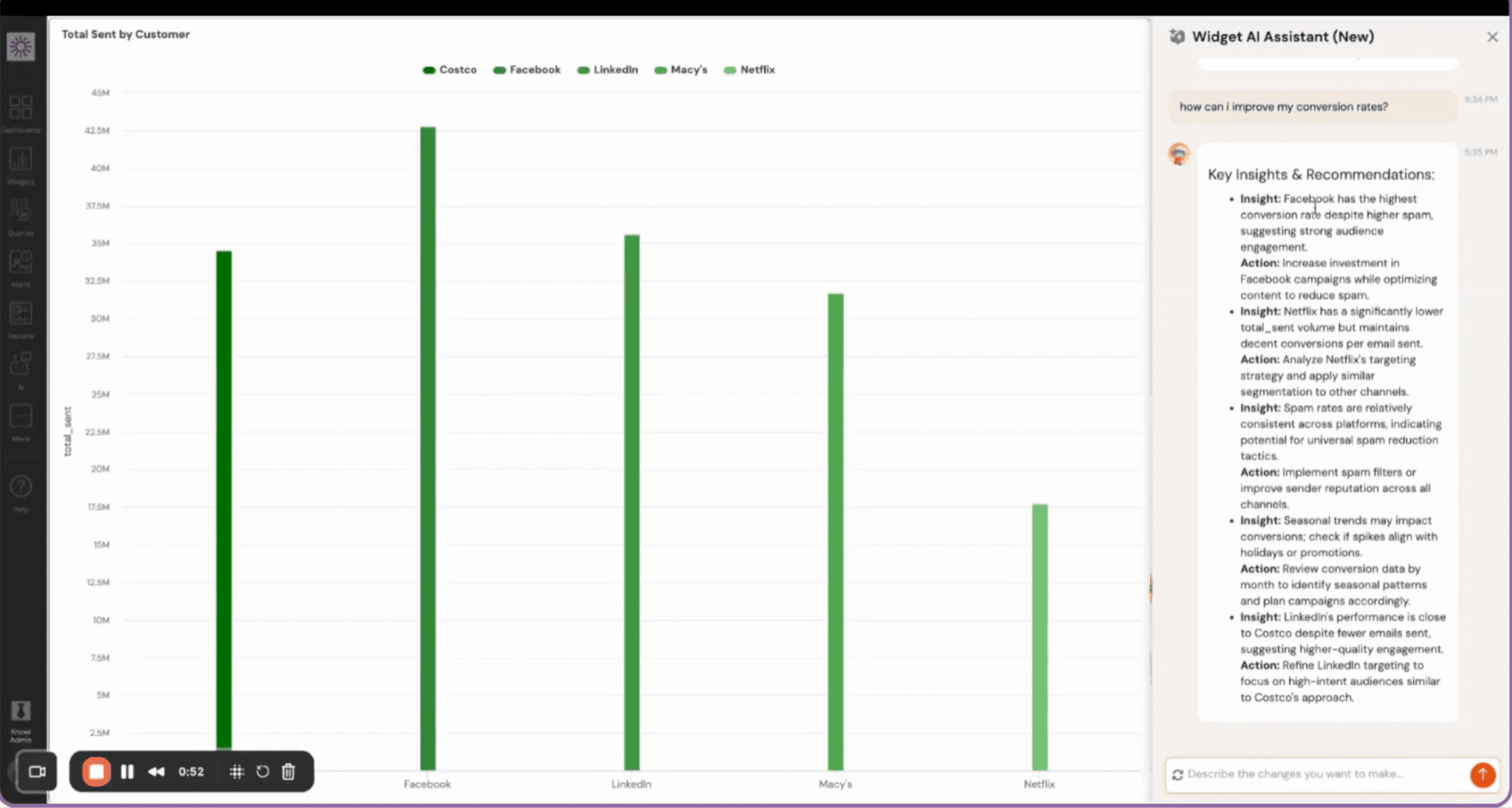
See Agentic AI in Action (Widget AI Assistant Demo)
Before we go deeper, here’s a quick look at how an AI assistant actually works inside a real dashboard:
This short demo shows what conversational, workflow-driven analytics looks like directly inside an application.
What Makes Agentic AI Different
Traditional AI in BI has been limited to:
Pre-built insights ("Sales are up 15% this quarter")
Simple chatbots with predetermined responses
Automated alerts for obvious patterns
Agentic AI goes far beyond this. It can:
Understand complex, multi-part questions
Navigate your specific data architecture
Perform multi-step workflows autonomously
Generate actionable recommendations
Take actions based on insights
The Multi-Step Workflow Revolution
Here's where it gets powerful. Instead of asking for data and then manually acting on it, you can request complete workflows:
Traditional approach:
Log into BI tool
Navigate to correct dashboard
Filter data for specific criteria
Export results
Format for presentation
Email to stakeholders
Schedule follow-up analysis
Agentic AI approach: "Get me all high-priority issues from yesterday from our Zendesk, send me an email report, and give me insights and recommendations in the same chat."
One request, and the whole workflow is completed automatically.
Real-World Applications Across Industries
Contact Centers & Customer Support
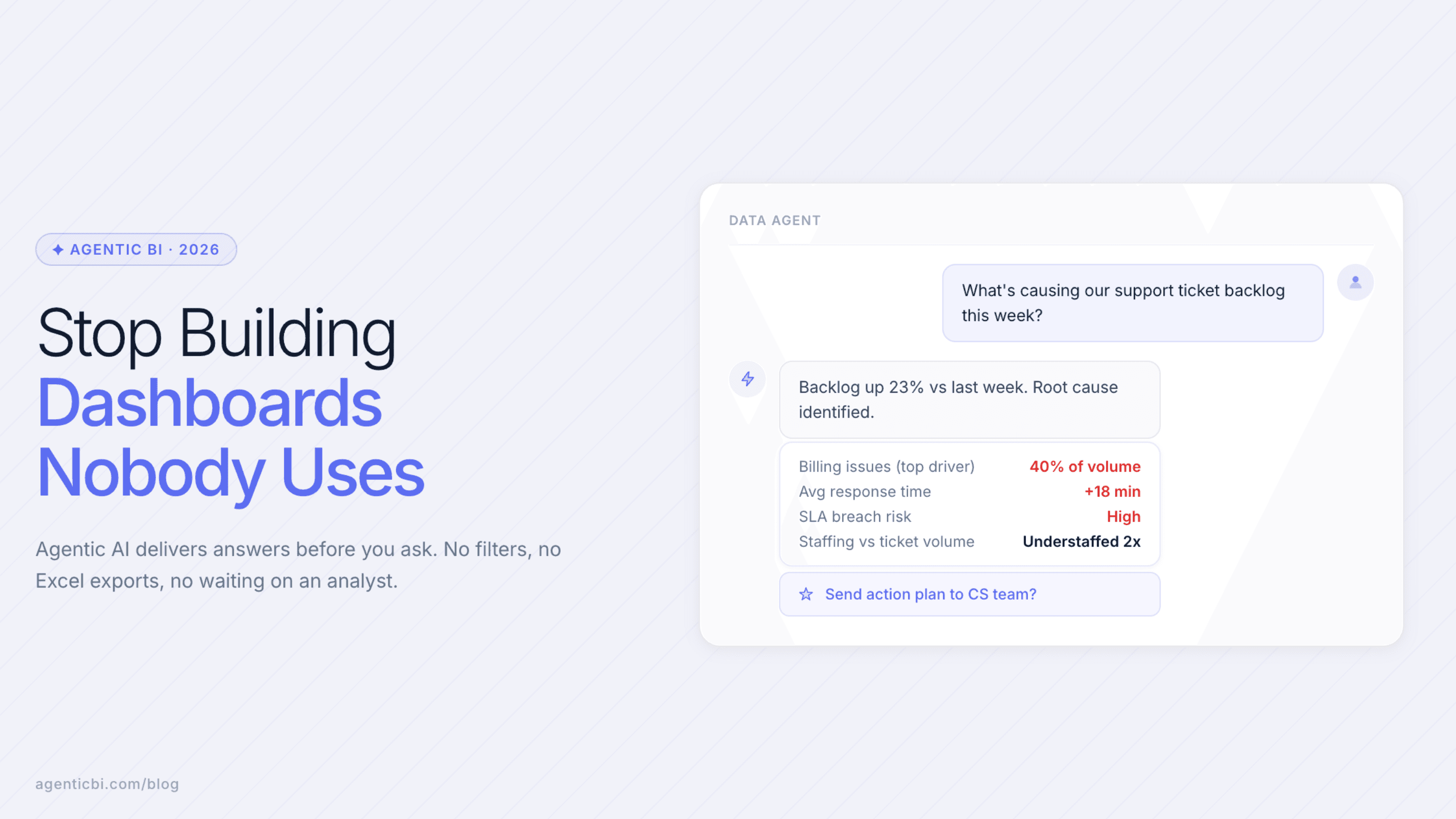
Support environments generate massive amounts of operational data: response times, ticket categories, SLAs, backlog trends. Traditionally, teams rely on dashboards that require constant filtering and interpretation. With Agentic AI, the entire workflow becomes conversational.
Example agent requests:
Automated incident analysis: "Why are response times increasing this week?"
The agent correlates ticket volume, staffing levels, backlog patterns, and issue categories to explain the rise.
Proactive recommendations: "What should we do to prevent future escalations?"
It identifies drivers of escalations and generates proactive recommendations—training gaps, process bottlenecks, or specific issue types.
Dynamic reporting: "Create a customer health dashboard for our biggest client"
The agent builds and saves a real-time view automatically, no analyst needed.
Outcome: Faster resolution, more proactive support, and less dependency on BI teams.
Sales & Marketing
Sales and marketing teams often drown in CRM fields, pipeline stages, attribution data, and campaign metrics. Agentic AI turns all of that into intelligent, contextual answers.
Example agent requests:
Pipeline intelligence: "Which deals are at risk and why?"
The agent evaluates activity levels, timelines, competitor mentions, product fit, and engagement signals to surface risk factors.
Campaign optimization: "What content performs best for enterprise prospects?"
It connects campaign analytics with segment data and generates insights with explanations.
Competitive analysis: "How do our win rates compare by industry?"
It calculates win/loss data, filters by industry, and presents trends and outliers instantly.
Outcome: Clear pipeline visibility, smarter prioritization, and more efficient campaign decisions.
Operations & Supply Chain
Operations and supply chain depend on real-time visibility: inventory, delays, equipment behavior, vendor performance. Dashboards struggle to capture the nuance and speed needed. Agentic AI closes the loop.
Example agent requests:
Performance monitoring: "Alert me to any shipping delays affecting key customers"
The agent monitors real-time feeds and proactively triggers alerts.
Predictive maintenance: "Which equipment needs attention based on recent patterns?"
Using anomaly detection, it identifies early warning signals before failures happen.
Cost optimization: "Where can we reduce expenses without impacting quality?"
The agent analyzes cost centers, identifies inefficiencies, and suggests opportunities for optimization.
Outcome: Better forecasting, reduced downtime, and stronger operational control.
The Security and Governance Advantage
One major concern with AI-powered analytics is data security. Agentic AI in platforms like Knowi addresses this through:
Private AI Processing
No data sent to public language models
All processing happens within your security perimeter
Complete audit trails of AI actions and recommendations
Intelligent Governance
Respects existing user permissions and data access controls
Maintains the same security boundaries as your current BI tools
Provides explanations for recommendations with data lineage
Contextual Intelligence
The AI agent understands your specific business context, data relationships, and organizational structure, leading to more relevant and actionable insights.
The Competitive Intelligence Edge
Early adopters of Agentic AI are gaining significant advantages:
Speed to Insight
Questions answered in seconds, not hours
No waiting for analyst availability
Immediate access to complex analysis
Democratized Analytics
Non-technical users can get sophisticated insights
Reduced dependency on data teams for routine analysis
Faster decision-making across all organizational levels
Continuous Learning
AI improves understanding of your business over time
Learns from user questions and feedback
Develops increasingly sophisticated recommendations
Implementation: What This Looks Like in Practice
The Chat Interface Revolution
Imagine your business intelligence working like this:
You: "Show me our customer satisfaction trends for enterprise accounts over the last quarter"
AI Agent: Generates visualization "Enterprise customer satisfaction has declined 8% from 4.2 to 3.9. The primary drivers appear to be response time increases and billing question resolution. Would you like me to break this down by specific issues or create an action plan?"
You: "Create an action plan and send it to the customer success team"
AI Agent: Analyzes patterns, generates recommendations, formats report, sends via email "Action plan sent to CS team. Key recommendations include: 1) Dedicated enterprise support queue, 2) Billing specialist training, 3) Proactive check-ins for accounts showing satisfaction decline. Should I set up monitoring for these metrics?"
The API Integration Future
Beyond chat interfaces, Agentic AI becomes a data agent that can be integrated into any workflow:
CRM systems: Automatic account health scoring with explanations
Project management tools: Resource allocation recommendations
Customer portals: Self-service analytics for enterprise clients
Slack/Teams: Instant answers to data questions without leaving conversation flows
What This Means for Your Organization
For Executives
Faster access to strategic insights
Reduced dependency on data teams for routine questions
More informed decision-making across the organization
For Analysts
Focus on strategic analysis instead of routine reporting
Enhanced capabilities through AI augmentation
More time for proactive business partnership
For End Users
Answers to data questions without learning complex tools
Proactive insights delivered in natural language
Ability to act on data without technical expertise
The Questions Every Leader Should Be Asking
How much time does your team spend formatting reports instead of analyzing insights?
What decisions get delayed because accessing the right data is too complicated?
How many business users avoid your BI tools because they're too complex?
What would change if anyone could have a conversation with your data?
How quickly can you adapt when your business questions evolve?
Getting Started: The Implementation Path
Phase 1: Assessment
Identify most common data questions across teams
Map current pain points in data access and analysis
Evaluate existing data infrastructure readiness
Phase 2: Pilot Program
Start with specific use cases (customer support, sales pipeline, operations)
Train AI agent on your data relationships and business context
Gather user feedback and refine capabilities
Phase 3: Scale and Integrate
Expand to additional use cases and user groups
Integrate with existing workflows and tools
Develop custom agents for specific business processes
The Future Is Conversational
We're moving toward a world where:
Data literacy becomes conversational fluency
Insights are delivered proactively, not on-demand
Every employee has access to enterprise-grade analytics
AI agents handle routine analysis, humans focus on strategy
The organizations that embrace this shift early will have a significant advantage over those still building better dashboards.
What's Next?
Agentic AI isn't just an improvement to existing BI, it's a fundamental shift in how we interact with data. The question isn't whether this future will arrive, but whether your organization will lead the transformation or react to it.
Key Considerations:
Start with specific, high-value use cases
Ensure security and governance from day one
Plan for organization-wide adoption, not just technical teams
Choose platforms that can evolve with your needs
Ready to explore how Agentic AI analytics could transform your organization? The future of business intelligence isn't about better charts, it's about better conversations with your data. Join the Waitlist.
Try AgenticBI
The AI data analyst for teams without a data team
Your numbers live in your database, your tools, and a dozen spreadsheet tabs, each telling a slightly different story. AgenticBI connects to all of them, runs the query, and hands back one answer. You ask in your own words. Agents do the analysis. And it can run on its own AI, so your data never leaves for a third party.
What you can do with AgenticBI:
Ask a question and get an answer with a chart, backed by the exact query, so you can trace it.
Get MRR, churn, CAC, and LTV on demand, without waiting for an analyst.
Send any answer to Slack, Teams, or email, once or on a schedule.
Connect SQL, NoSQL, and REST APIs through one agent, with no warehouse to build first.
Ask from Claude, ChatGPT, or Cursor through the AgenticBI MCP.
Free to start. Your data can stay yours, nothing goes to OpenAI or any outside model.
Start Free Trial →
Private AINo credit card
Learn more
Discover more from the latest posts.


