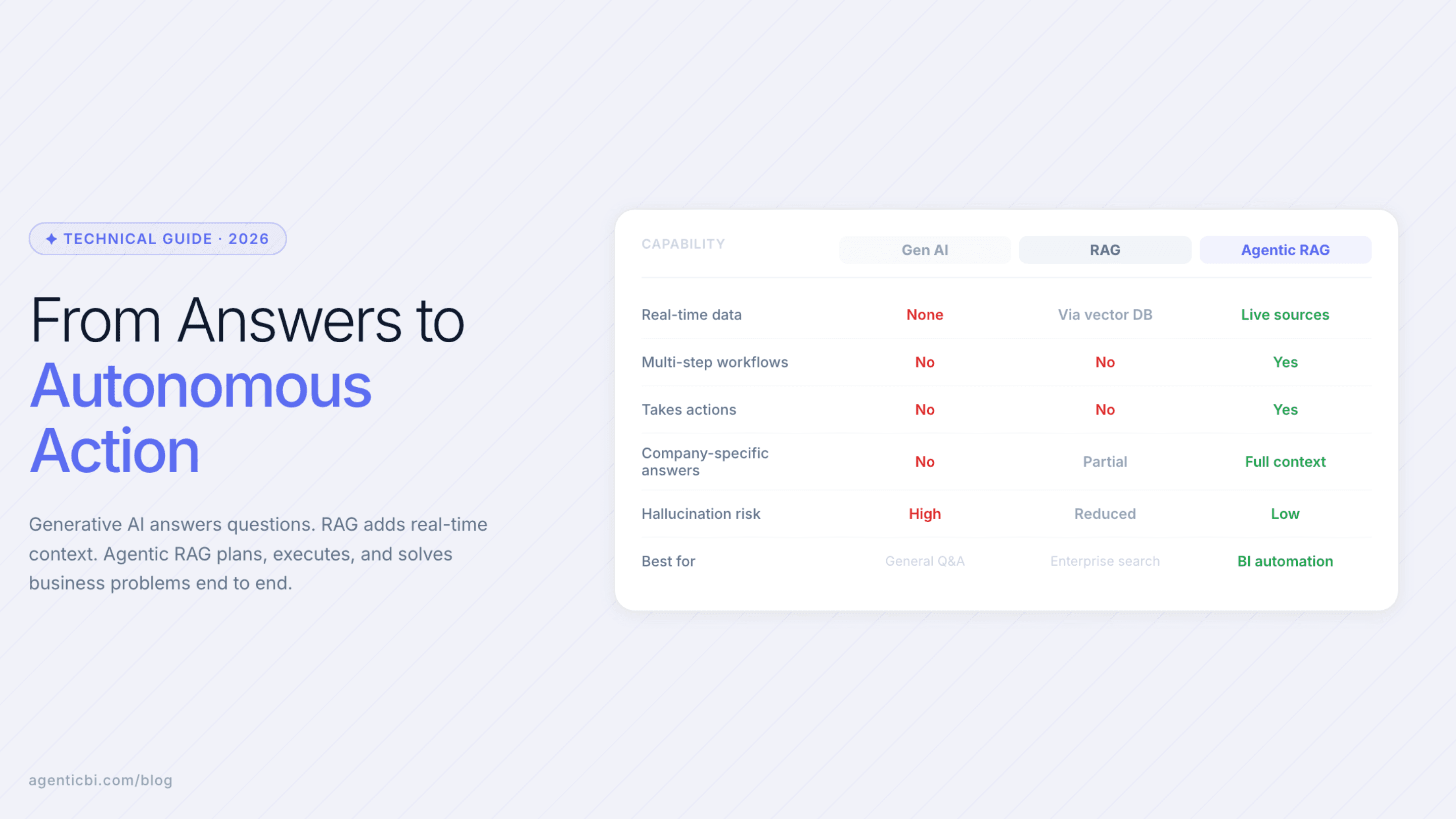
How AI Has Evolved From Simple Text Generation to Autonomous Workflow Orchestration
TL;DR
AI has evolved through three key stages: Generative AI (answers based on training data), RAG (adds real-time context from databases), and Agentic RAG (autonomous multi-step problem solving).
For analytics teams, this evolution means moving from manual questioning to autonomous insight discovery and action execution.
Agentic RAG is the future of intelligent systems that don’t just answer questions - they solve complex business problems independently.
Table of Contents
The AI landscape has rapidly evolved from basic text generation to sophisticated systems that can reason, retrieve, and act autonomously. Understanding the differences between Generative AI, RAG (Retrieval-Augmented Generation), and Agentic RAG is crucial for anyone building intelligent applications, especially in analytics and business intelligence.
Let’s break down each approach and understand why this evolution matters for enterprise applications.
Generative AI: The Foundation
Generative AI represents the simplest form of AI interaction, relying entirely on pre-trained knowledge.
How it works
User asks a question
The LLM retrieves information from training data
Response is generated without external context
Example
User: “What is customer churn?”
AI: “Customer churn is the percentage of customers who stop using a service during a given time period…”
Limitations
Knowledge cutoff
No real-time data
Generic, non-company-specific answers
Higher hallucination risk
RAG: Adding Context and Currency
RAG solves the knowledge limitation by supplementing the LLM with external, searchable information.
How it works
User asks a question
Vector database is searched
Retrieved context is injected into the prompt
LLM generates a grounded response
Example
User: “What is our customer churn rate this quarter?”
System: Searches vector DB → retrieves Q3 data
AI: “Your Q3 churn rate is 8.2%, up from 7.1% last quarter…”
Advantages over Generative AI
Current information
Company-specific answers
Reduced hallucinations
No retraining required to update data
Limitations
Still single-step
No workflow execution
Limited planning and reasoning
Agentic RAG: Autonomous Workflow Intelligence
Agentic RAG represents the most advanced evolution, systems that plan, reason, and execute multi-step workflows autonomously.
How it works
User asks a question or defines a goal
Orchestrator identifies intent and available agents (via Model Context Protocol)
Multi-step plan is created
Specialized agents execute tasks
Missing information is requested if needed
Final action, analysis, or summary is produced
Both the orchestrator and agents are powered by the LLM.
Example
User: “Why is our customer churn increasing and what should we do about it?”
Agentic workflow
Data Agent: Pulls churn data
Analysis Agent: Identifies SMB churn spike
Insight Agent: Correlates spike with pricing changes
Strategy Agent: Proposes retention plan
Action Agent: Creates CRM retention campaign
Response
“Churn increased due to pricing sensitivity in SMB accounts. I’ve identified 847 at-risk customers and created a retention campaign. Approve to deploy.”
Advantages
Autonomous problem solving
Multi-step workflows
Context-aware planning
Can take real actions
Adaptive reasoning
Why This Evolution Matters for Analytics
Traditional analytics challenges
Users must know what to ask
Technical skills required
Manual insight → action loop
Dashboard-limited workflows
Agentic RAG changes this
Proactive insight discovery
Natural language interaction
End-to-end automation
Always-on monitoring and execution
Choosing the Right Approach
Use Generative AI when
General knowledge queries
Content creation
No real-time or company-specific data needed
Use RAG when
You need current, contextual answers
One-shot question answering
Enterprise search or knowledge systems
Use Agentic RAG when
Multi-step business processes are involved
Autonomous decision-making is required
You want full workflow automation
Systems need to act, not just answer
The Future Is Agentic
The evolution from Generative AI → RAG → Agentic RAG is a shift from answering questions to solving business problems autonomously.
For analytics teams, this means moving from:
“What happened?”
to
“Here’s what’s happening, why, and what I’m doing about it.”
The question isn’t if organizations will adopt agentic systems, it’s who leads and who falls behind.
See Agentic BI in action for analytics
AgenticBI’s specialized agents execute insights → actions without manual intervention.
See Analytics Agents in Action
Frequently Asked Questions
Q: What’s the main difference between RAG and Agentic RAG?
A: RAG retrieves and answers single questions. Agentic RAG plans and executes multi-step workflows autonomously.
Q: Do I need to choose one approach?
A: No. Enterprises typically use all three depending on the use case.
Q: What is Model Context Protocol?
A: It’s the orchestrator’s capability directory that defines available agents and their requirements.
Q: Is Agentic RAG more expensive?
A: Initially yes, but it replaces workflows that normally require multiple humans, delivering strong ROI.
Q: How does Agentic RAG prevent errors?
A: Through validation steps, backtracking, and continuous context evaluation.
Q: Can it work with existing systems?
A: Yes. It integrates via APIs with CRMs, databases, analytics platforms, and more.
Q: What if an agent fails?
A: The orchestrator retries, reroutes tasks, or escalates to humans.
Q: How do I know if my organization is ready?
A: Look for complex workflows, fragmented data sources, and processes requiring heavy human coordination.
Try AgenticBI
The AI data analyst for teams without a data team
Your numbers live in your database, your tools, and a dozen spreadsheet tabs, each telling a slightly different story. AgenticBI connects to all of them, runs the query, and hands back one answer. You ask in your own words. Agents do the analysis. And it can run on its own AI, so your data never leaves for a third party.
What you can do with AgenticBI:
Free to start. Your data can stay yours, nothing goes to OpenAI or any outside model.
Learn more
Discover more from the latest posts.


