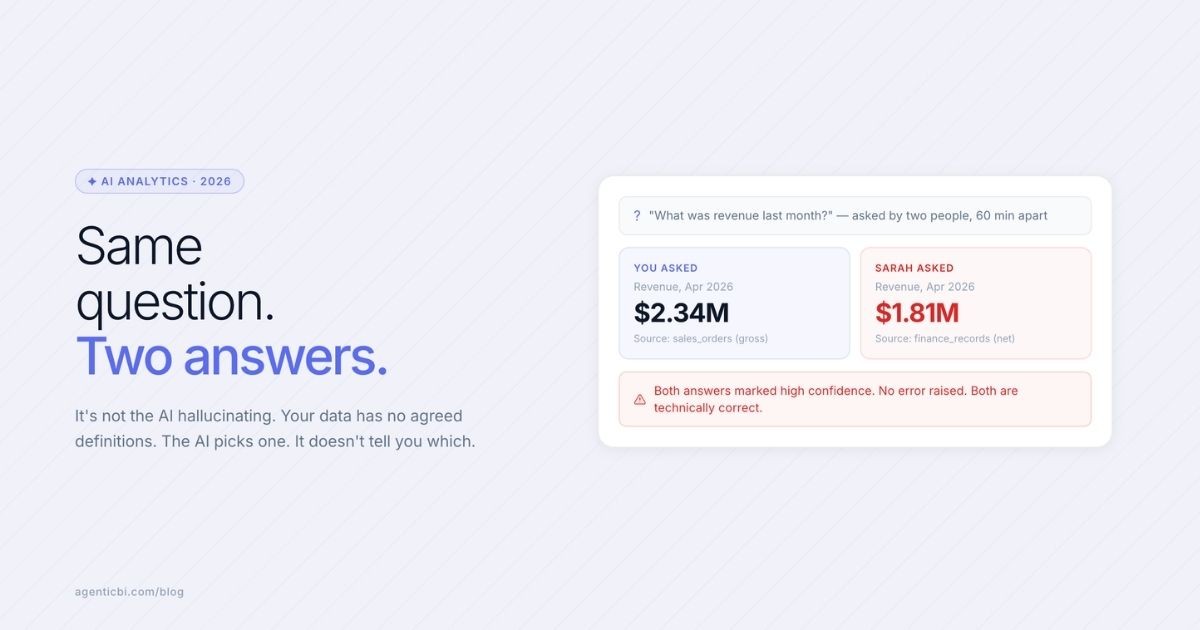
Two People Asked the AI the Same Question. Different Numbers.
Someone on your team asks the AI what your revenue was last month. They get a number.
Someone else asks the same question an hour later. Different number.
Neither of them is wrong. Neither of them knows why it happened. Both of them stop trusting your AI analytics tool by the end of the week.
This is the trust problem. And it's not the AI's fault.
It's Not Hallucination. It's Your Data.
When AI analytics returns the wrong answer, the first instinct is to blame the model. The AI got it wrong. It hallucinated. Maybe switch to a better LLM.
That diagnosis is almost always wrong.
The AI didn't make anything up. It found a column called "revenue" and returned what was in it. The problem is that three tables in your database all have something that looks like "revenue," and they each calculate it slightly differently.
Sales counts pipeline at 90% confidence. Finance counts closed-won deals, net of refunds. Your product event table counts something else. All three are real. All three exist in your database.
The AI picks whichever one it lands on. It doesn't know which one you meant. It doesn't signal uncertainty. It returns a chart.
Why a Human Analyst Wouldn't Do This
A human analyst who's been at your company for six months knows things the schema doesn't tell you.
They know finance uses this table. They know the "created_at" timestamp is in UTC and needs converting for US reporting. They know that column from the 2019 import is deprecated and shouldn't be touched.
AI analytics removes that mediating layer by design. Speed is the point. You type a question, you get an answer.
When that layer is gone and your data has inconsistent definitions, the AI delivers inconsistent answers at the speed of a text message. The faster it goes, the faster the wrong numbers spread.
This is one reason AI analytics projects stall at scale.
What Actually Fixes It
Better prompting doesn't fix this. A faster model doesn't fix this. A higher confidence threshold doesn't fix this.
The fix is upstream, in the data. Three things need to be in place before your AI queries anything:
Agreed definitions. What does "revenue" mean? Which table? Gross or net? What counts as "last month" in your time zone? Lock that down once.
A single query foundation. Every question, from every person, answered from the same definition layer. Not from whichever table the AI lands on first.
Traceability. When the AI says $2.3M, you can see which rows, which table, which business rules produced that number.
That's how trust in AI analytics gets built. Not by improving the model. By improving what the model queries.
AgenticBI builds this in. You define your metrics before your AI touches them. Every question gets answered from the same agreed definition.
Go deeper with Knowi
For a deeper look at the governance failures behind AI analytics trust problems, including enterprise patterns that prevent them and what trusted AI analytics actually looks like, read the full post on Knowi.
Read: AI Analytics Has a Trust Problem. Here's the Real Cause. →
Related reading:
Why AI Analytics Gives Wrong Answers and How Governed Data Fixes It
Try AgenticBI
The AI data analyst for teams without a data team
Your numbers live in your database, your tools, and a dozen spreadsheet tabs, each telling a slightly different story. AgenticBI connects to all of them, runs the query, and hands back one answer. You ask in your own words. Agents do the analysis. And it can run on its own AI, so your data never leaves for a third party.
What you can do with AgenticBI:
Free to start. Your data can stay yours, nothing goes to OpenAI or any outside model.
Learn more
Discover more from the latest posts.


