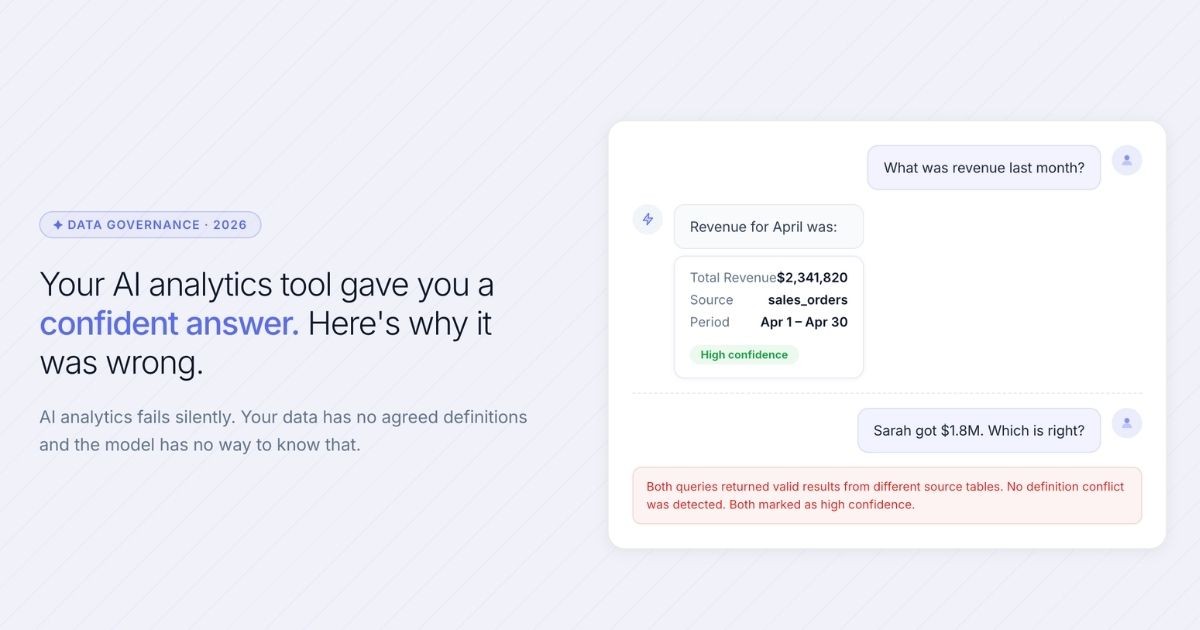
Your AI analytics tool gave you a confident answer. Here's why it was wrong.
You asked your AI analytics tool a question. It answered immediately. The chart looked right. The numbers made sense.
They were wrong.
Not because the AI made something up. Because your data doesn't have agreed definitions, and the AI had no way to know that.
This is the failure mode nobody mentions when AI analytics goes sideways.
"Revenue" Means Three Different Things in Your Database
In most companies, the same word lives in multiple places with slightly different meanings.
"Revenue" in one table is gross. In another it's net. In a third it's pipeline at 90% confidence. All three exist in your database. All three are real. The AI picks one and returns a confident chart.
Nobody told it which one you meant.
This isn't a bug in the model. It's what happens when AI connects directly to raw data without anything in between that says what the data actually means.
Why Faster AI Makes This Worse
A human analyst would pause. They'd ask which revenue definition you're using. They'd check two tables and flag the discrepancy.
AI doesn't pause. It answers. Immediately.
The faster AI analytics goes, the faster inconsistent answers move through your team. Two people ask the same question on a Monday morning. They get different numbers. Neither knows why. Both stop trusting the tool by Friday.
What Your AI Actually Needs Before It Touches Your Data
Access isn't enough. Your AI needs definitions.
What does "revenue" mean for your business? Gross or net? Which table? Which time zone for "last week"?
What is each person allowed to see? If someone on your sales team asks about revenue by customer, should they see all customers or just their own?
How was the number calculated? If the AI says $2.3M, can you trace that back to which rows, which business rules, which transformations ran?
A governed data layer handles all three. It sits between your raw data and your AI. It defines what things mean, enforces who sees what, and logs how every answer was derived.
Without it, you're not running AI analytics. You're running a very fast, very confident way to get the wrong answer.
At scale, this compounds fast. See the AI analytics scaling problem.
If You Don't Have a Data Engineer
This sounds like enterprise infrastructure. It doesn't have to be.
The key move is locking down the one or two metrics that actually matter for your decisions. What's your actual MRR? What counts as an "active user"? What does "customer" mean in your context?
Define that before your AI queries it. Build that definition into the layer it queries from.
AgenticBI handles this without requiring you to build the layer yourself. You connect your data, define what it means, and every question gets answered from that definition instead of from whatever the schema implies
Go deeper
For a detailed understanding of how governed data layers work in AI analytics, including the full architecture, lineage requirements, and enterprise governance patterns, read the full post on Knowi.
Read: Why AI Analytics Fails Without Governed Data Layers →
Related reading:
Try AgenticBI
The AI data analyst for teams without a data team
Your numbers live in your database, your tools, and a dozen spreadsheet tabs, each telling a slightly different story. AgenticBI connects to all of them, runs the query, and hands back one answer. You ask in your own words. Agents do the analysis. And it can run on its own AI, so your data never leaves for a third party.
What you can do with AgenticBI:
Free to start. Your data can stay yours, nothing goes to OpenAI or any outside model.
Learn more
Discover more from the latest posts.


