
Stripe and GA4 Don't Match: Why Revenue Numbers Disagree
Stripe and GA4 disagree because they measure different things, at different times, with different losses. Stripe records money on the server, the moment it moves. GA4 records browser events, and only when the script loads, the cookie is allowed, and the session survives checkout. Neither number is wrong. They're answering different questions.
Quick Summary (TL;DR)
Stripe counts charges server-side. GA4 counts purchase events in the browser. Different systems, different losses.
Ad blockers stop GA4's script before it runs. On technical audiences, more than half of visitors can go untracked.
Renewals, refunds, and disputes happen with no browser open. GA4 never sees them unless you build a pipe for them.
Stripe's hosted Checkout can break the session, so the sale comes back as "direct."
Expect GA4 to capture only a share of Stripe revenue, and how big a share depends on your buyers. A stable gap is normal. A moving one is the real signal.
The fix isn't picking a winner. It's asking one question across both.
Stripe vs GA4 at a glance
Stripe | GA4 | |
|---|---|---|
What it records | Charges, on the server | Purchase events, in the browser |
When it records | The moment money moves | Only if the script loads, consent is given, and the session survives checkout |
Sees renewals, refunds, disputes | Yes | No, unless you pipe them in |
Affected by ad blockers | No | Yes |
Attribution | None, just a timestamp | Lookback windows; can reattribute up to 7 days later |
Best used as | The source of truth for revenue | The direction of behavior and channels |
Why the numbers disagree
Six mechanisms drive the gap. Most teams are hit by three or four at once.
Ad blockers kill GA4 before it loads
GA4 lives in a JavaScript snippet. Block the script and the purchase event never fires. Stripe doesn't care. It records the charge on the server either way.
The scale depends entirely on your audience. Roughly 32.5% of internet users run an ad blocker globally. On a general-audience site, about 13% of visitors block Google Analytics. On sites with traffic from Hacker News and Reddit, one measurement found 58% of visitors blocking GA, in a comparison of 50,947 visitors against the 21,054 that GA saw. Firefox users blocked it 88% of the time. Linux users, 82%.
If you sell software, your buyers are developers and technical operators, the cohort GA4 misses the most. The people most likely to pay you are the people GA4 is least likely to see.
Consent mode turns some revenue into an estimate
Since March 6, 2024, Consent Mode v2 is mandatory for Google's ad features on EEA traffic. When a visitor declines, GA4 gets cookieless pings instead of real events.
Google then fills the hole with behavioral modeling, but only above thresholds: at least 1,000 denied-consent events per day for 7 days, plus 1,000 daily consenting users on 7 of the prior 28 days. Most startups sit below both. Below the line, declined visitors are simply invisible. Above it, part of your GA4 "revenue" is a machine-learning estimate, not a count.
Renewals, refunds, and disputes never reach GA4
This one compounds every month for a subscription business. A renewal is a server-side charge. Nobody opens a browser. Nothing fires. GA4 doesn't know it happened.
Refunds need an explicit refund event with a matching transaction_id, which almost nobody sends. Disputes are worse: the card network immediately reverses the payment and Stripe debits your balance plus a fee. Stripe's net revenue moves down. GA4's stays exactly where it was.
So GA4 overstates on refunds and understates on renewals, at the same time.
Stripe Checkout breaks the session
Hosted Checkout takes the buyer off your domain. The _gl cross-domain parameter often doesn't survive the round trip, so the purchaser comes back looking like a new visitor. Stripe documents the funnel-analysis problem itself, and practitioners have written whole guides on keeping the session alive. The revenue lands in GA4, but attributed to "direct" or a stripe.com referral. Your ad channels look worse than they are.
GA4 assigns credit. Stripe stamps a timestamp.
Stripe has no concept of attribution. A charge happened at 14:32 UTC. Done.
GA4 credits key events through lookback windows: 30 days for acquisition, up to 90 for everything else, with data-driven attribution as the default. It can reattribute conversions up to 7 days after they happen. And fresh data keeps shifting for 24 to 48 hours while processing finishes. Compare Tuesday's Stripe against Tuesday's GA4 on Wednesday morning and you're comparing a closed ledger to wet paint.
Timezones and currency finish the job
GA4 reports in your property's reporting timezone. Stripe defaults to UTC. Every month-end payment near midnight lands in different months in each tool.
Multi-currency? GA4 converts at the prior day's exchange rate. Stripe converts at its own rate at charge time, plus a conversion fee. Same sale, two rates, two days.
How big is the gap, really
Vendors selling trackers will tell you a third of your revenue is missing. Sometimes true, often not. The rough picture:
General consumer audience: the gap tends to be small.
Technical audience (developers, IT, SaaS buyers): more than half of visitors can be invisible, and revenue capture drops with them.
Founders keep rediscovering this the hard way. Teams routinely find a large share of their conversions never tracked, which can make cost per acquisition look far worse than reality and drag down the ROAS numbers in the ad platforms, even while Stripe shows revenue climbing. The pattern is sharpest with technical buyers: they block the GA script but still land in your server logs and in Stripe, because a server-side charge cannot be blocked.
Here's the practical read: a stable gap is fine. If GA4 consistently shows 80% of Stripe, you can work with that. What matters is when the ratio moves. That's a broken tag, a consent banner change, or a real revenue shift hiding behind a measurement artifact.
What people actually do about it
Four options, in ascending order of effort.
1. The spreadsheet. Export both, line them up, explain the difference by hand. Free, and it never quite ties out. Stripe even publishes reconciliation guides for the payout side. You'll do this monthly, forever, and the numbers will be stale by the time you finish.
2. Server-side tagging. Move the GA4 tag to a server you control so blockers can't kill it. Real fix, real cost: Google's own Cloud Run setup guide works out to roughly $45 per month per server, with a minimum of two instances recommended, so $90+ per month before you've configured anything. Managed services like Stape start around $20 per month. You still need someone who understands tagging.
3. Stripe webhooks into GA4's Measurement Protocol. Send Stripe webhook events into GA4 via the Measurement Protocol. This is the only way renewals and refunds ever reach GA4. It's free, minus the engineering time. The hard part is carrying the GA client ID into Stripe metadata at checkout so the two systems can agree on who bought.
4. Stop asking GA4 about money. Treat Stripe as the source of truth for revenue, use a lightweight analytics tool for traffic, and stop expecting them to match. It's the cheapest fix, and the most accurate one. Its weakness: you lose the connection between marketing behavior and revenue entirely.
Stop reconciling in a spreadsheet.
Connect Stripe and GA4 to AgenticBI and ask where last month's revenue diverged. The agents pull both sources, join them, and hand back the gap as a number.
We built a fake company to show the gap
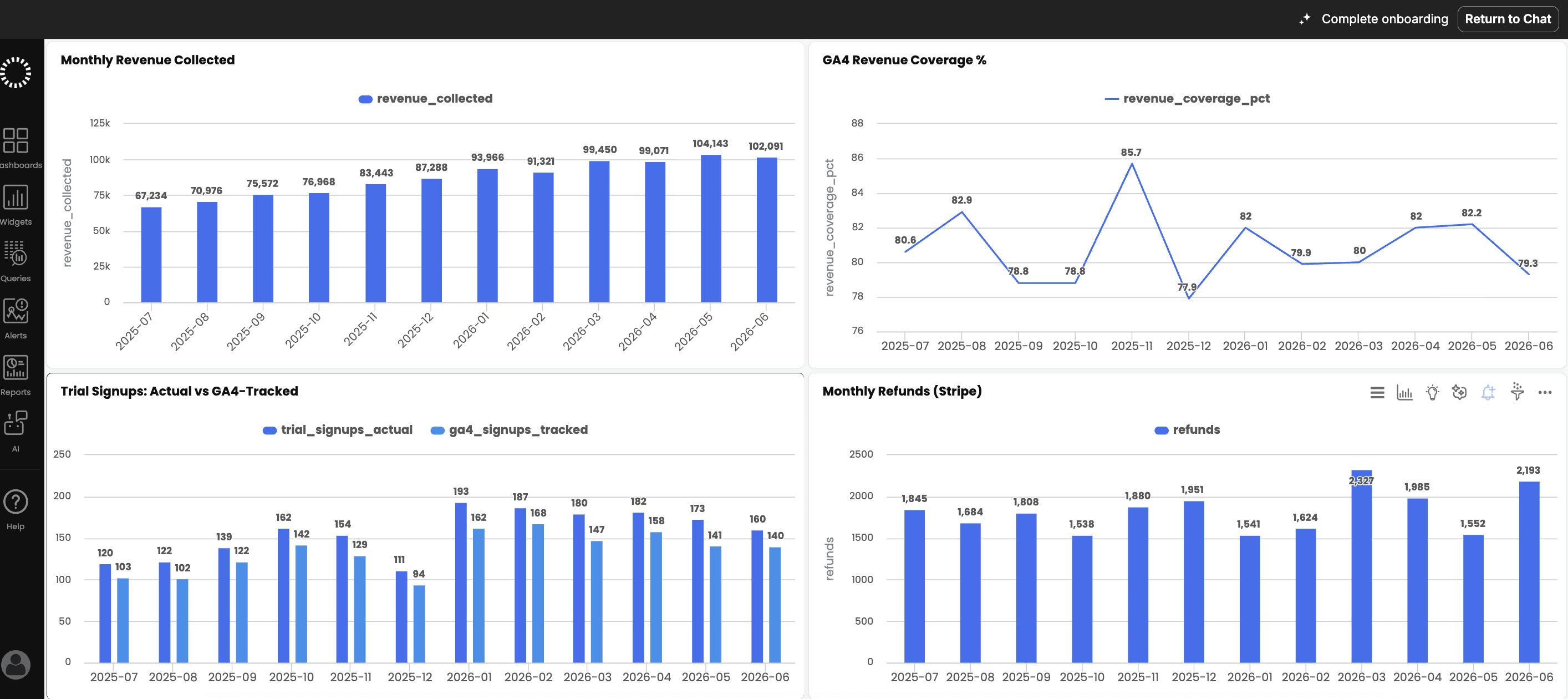
Reading about the gap is one thing. Watching it is better. So we built Sundial, a fictional 8-person SaaS company, and generated a full year of realistic Stripe, GA4, and CRM data for it: subscriptions, renewals, refunds, ad-blocked sessions, the works. Then we pointed dashboards at it, without writing SQL.
The result: GA4 tracked between 79% and 86% of Stripe net revenue. Every single month. Never once did the two agree.
June was the widest gap. Stripe netted $104,616. GA4 reported $82,952. That's 79.3% capture, and $21,664 of real, collected revenue that the marketing analytics never saw. If Sundial's founder judged June by GA4, they'd think revenue dipped. Stripe says it was the best month of the quarter.
The CRM told a third story, and this is the part that catches founders off guard. The CRM books full annual contract value on the day a deal closes. Stripe collects it monthly. So a big Q2 close makes the CRM spike in May while Stripe shows a modest bump that repeats for twelve months. Three tools, three curves, one company.
The only real fix is one question across both
Every option above tries to make one tool agree with the other. That never fully works, because the disagreement is structural. The version that works is asking a single question across both sources at once: "show me June revenue from Stripe next to June purchase revenue from GA4, and tell me where they diverge." That's the job agentic BI exists for, and it's what an AI data analyst does that a dashboard can't: it queries Stripe and GA4 in the same breath, joins them, and hands back the gap as a number instead of a mystery.
That's what we built AgenticBI to do. Connect Stripe. Connect GA4. Ask what one saw that the other didn't. Try it free, it takes about five minutes.
Frequently asked
Does GA4 sample revenue data in standard reports?
No. Standard GA4 reports are always unsampled. Sampling only kicks in for Explorations and API queries above 10 million events. What can bite you instead is data thresholding: when reports include demographics or Google signals data at low volumes, GA4 silently withholds rows to prevent identifying individual users. Your totals survive, but rows go missing, and you can't turn it off.
How do I get Stripe subscription renewals to show up in Google Analytics?
You have to send them yourself. Renewals are server-side charges with no browser session, so the only route is a Stripe webhook that fires a purchase event into GA4's Measurement Protocol. The tricky part is stashing the GA client ID in Stripe metadata during the original checkout, so the renewal ties back to the right user instead of appearing as anonymous revenue.
Why does Stripe show up as "direct" or a referral in GA4?
Hosted Stripe Checkout redirects the buyer off your domain, and the _gl cross-domain linking parameter often doesn't survive the trip back. GA4 starts a fresh session and credits the purchase to "direct" or a stripe.com referral. Stripe documents the funnel gap, and the workarounds involve configuring cross-domain measurement or manually preserving the session. Embedded checkout avoids the redirect entirely.
Is server-side tagging worth it for a small SaaS?
Do the math against your ad spend. Self-hosting on Cloud Run runs about $45 per server per month with two instances recommended, so $90+ before setup time. Managed options like Stape start near $20 per month. If you spend real money on paid acquisition, recovering blocked purchase events pays for itself fast. If you're not running ads, it fixes a number nobody is optimizing against, and it still won't capture renewals or refunds on its own.
Should I report revenue from Stripe or from GA4?
Stripe, always, for anything involving money: board decks, forecasts, MRR. It's the ledger. GA4's job is behavior and attribution direction: which channels and pages drive buyers, in relative terms. The trap is quoting GA4 revenue as if it were collected revenue. Teams that keep both honest either reconcile them on a schedule or query both sources together so the gap itself becomes a metric they watch.
Try AgenticBI
The AI data analyst for teams without a data team
Your numbers live in your database, your tools, and a dozen spreadsheet tabs, each telling a slightly different story. AgenticBI connects to all of them, runs the query, and hands back one answer. You ask in your own words. Agents do the analysis. And it can run on its own AI, so your data never leaves for a third party.
What you can do with AgenticBI:
Free to start. Your data can stay yours, nothing goes to OpenAI or any outside model.
Learn more
Discover more from the latest posts.


