Analytics Without a Data Warehouse: One Tool for Any Data
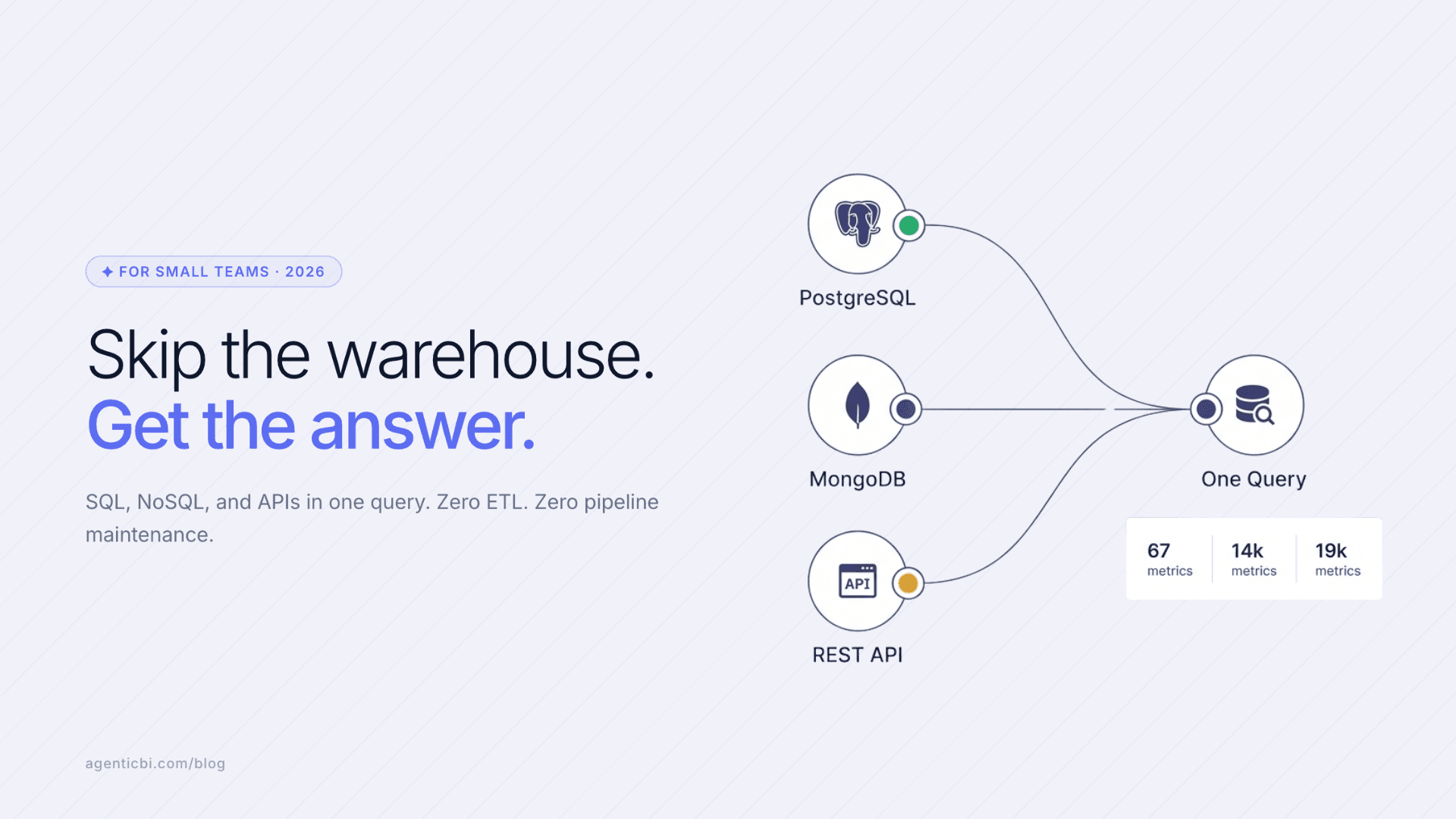
You don't need a data warehouse to get insights from your data. A single analytics platform can connect directly to SQL databases, NoSQL databases, and REST APIs, blend them in a single query, and surface answers in seconds: no ETL pipelines, no data movement, no dedicated data engineer required.
Quick Summary (TL;DR)
Most teams build a three-tool stack (ETL + warehouse + BI tool) when one platform can handle all three steps natively.
Data warehouses exist to normalize data before BI tools can read it. Tools that query sources directly skip this layer entirely.
A standard analytics stack costs $2,000-$10,000/month in tool licenses before accounting for engineering time to build and maintain pipelines.
AgenticBI connects directly to MongoDB, PostgreSQL, Elasticsearch, REST APIs, and 70+ other sources with no staging layer required.
Cross-source joins work without moving any data: MongoDB + Stripe API + PostgreSQL in one query, results returned combined.
Teams that remove the warehouse step go from question to answer in hours instead of sprint cycles.
Why Most Teams Think They Need a Warehouse
Traditional BI tools were built for a world where data lived in structured, relational tables. When your data is in MongoDB, Elasticsearch, or a REST API, those tools can't read it directly. The conventional fix is to extract it, transform it into rows and columns, and load it into a warehouse first.
This is where ETL pipelines come from. They're not a feature of modern analytics. They're a workaround for BI tools that can't connect to modern data sources.
If your analytics tool can query MongoDB natively, you don't need to flatten your documents first. If it can call a REST API directly, you don't need a pipeline to pull that data into Snowflake before you can chart it.
The Traditional Stack: Three Tools, One Job
The standard data stack looks like this: an ETL tool (Fivetran, Airbyte, Stitch) pulls data from your sources, a warehouse (Snowflake, BigQuery, Redshift) stores and structures it, and a BI tool (Looker, Tableau, Power BI) reads from the warehouse and builds dashboards. Each layer has a cost, a maintenance burden, and a failure mode.
Fivetran alone starts at $500/month for basic connectors. Snowflake credits add up fast once queries run frequently. The BI license adds another $500-$2,000/month depending on seats. That's before the engineering hours spent building connectors, fixing schema drift when an upstream API changes, and debugging sync failures at 2am.
The hidden cost is time. Building ETL pipelines, handling schema changes when sources update, and debugging failed syncs are recurring costs that compound as your data sources grow. A small team without a dedicated data engineer often finds the toolchain consuming more time than the actual analysis it was built to enable.
What "One Tool" Actually Means
A platform that queries data sources natively removes the middle layers. Instead of ETL to warehouse to BI, the flow is: connect, query, answer.
Native MongoDB support means querying nested documents directly using MQL, with no BI Connector, no document flattening, no staging copy. The same applies to Elasticsearch, Cassandra, InfluxDB, DynamoDB, and REST APIs as queryable data sources. Each source is queried in its own language, at its own location, without data moving anywhere.
Cross-source joins work the same way. Join your MongoDB user collection with your Stripe API data and your PostgreSQL billing table in one query. The results come back combined without a warehouse holding a copy of all three datasets. For a real-world example of this pattern, see how ClickHouse and Jira data can be joined live without a staging layer.
What This Looks Like in Practice
A SaaS founder wants to see which users upgraded to paid within 7 days of signup. The data lives in two places: MongoDB (signup events) and a Stripe API (payment records). In a traditional stack, an engineer builds a pipeline to sync both sources to a warehouse, models the join, and the dashboard is ready two weeks later.
With a single-tool approach, the query runs directly against both sources. The answer is available in minutes. When the founder asks a follow-up ("break it down by acquisition source"), the next query runs the same way, with no pipeline change required.
This is the shift that matters: from a reporting pipeline you maintain to a question you can ask.
Try AgenticBI free: AI agents that connect directly to your data, build dashboards, and deliver reports with no warehouse or ETL required. Start at AgenticBI.com.
When One Tool Works (and When a Warehouse Still Makes Sense)
Direct-source querying fits best when your data sources are your primary operational systems: MongoDB for your product database, PostgreSQL for billing, a REST API for a third-party integration. Queries run against live data, so dashboards are always current without a sync window.
The case for a dedicated warehouse strengthens in two scenarios: very large analytical queries across billions of rows that would strain production databases under heavy reporting load, or compliance requirements that mandate a separated analytical copy of data. For most teams under 200 people, neither condition applies.
The best agentic BI tools in 2026 increasingly support direct source connectivity as a baseline capability. The question has shifted from "do I need a warehouse?" to "which sources does my analytics tool support natively?"
For a detailed comparison of which AI analytics platforms support which sources natively, see how the major AI analytics platforms compare.
One Tool vs. Traditional Stack
Factor | Traditional Stack (ETL + Warehouse + BI) | AgenticBI (One Tool) |
|---|---|---|
Setup time | 2-8 weeks to build and validate pipelines | Hours to connect sources and run the first query |
Monthly tool cost | $2,000-$10,000+ across ETL, warehouse, and BI licenses | $0 to start, $99/month Pro plan |
Data freshness | Data copied into warehouse; sync lag on every update | Queries run at the source, always current |
Native NoSQL support | Requires ETL to flatten documents before warehouse ingestion | Direct queries against MongoDB, Elasticsearch, Cassandra |
REST API data | Requires a pipeline to pull and store API responses first | REST APIs treated as queryable sources natively |
Cross-source joins | Data must share the same warehouse schema to join | Join across sources in one query, no data movement |
Ongoing engineering | Continuous: pipeline builds, schema changes, failure debugging | Minimal: connect once, query from there |
Time to first answer | Days to weeks (pipeline build, model, dashboard) | Minutes (connect and query) |
Try AgenticBI free: AI agents that connect directly to your data, build dashboards, and deliver reports with no warehouse or ETL required. Start at AgenticBI.com.
Frequently Asked Questions
Can I do analytics without a data warehouse?
Yes. If your analytics platform can query your data sources natively (MongoDB, PostgreSQL, REST APIs) you don't need a warehouse to normalize data first. AgenticBI connects directly to each source and runs queries at the origin, eliminating the ETL and warehouse layer for most small and mid-size teams.
What is ETL and do I need it for analytics?
ETL (Extract, Transform, Load) is a process that copies data from your source systems into a warehouse so BI tools can read it. You need ETL if your BI tool can't connect to your data sources directly. If your analytics platform supports native connections to MongoDB, Elasticsearch, and REST APIs, ETL becomes optional rather than required.
How do I get insights from MongoDB without ETL?
Use an analytics platform that queries MongoDB natively using MQL, without requiring a BI Connector or document flattening. AgenticBI connects directly to MongoDB, supports nested document queries, and can join MongoDB data with SQL or API sources in a single query without a staging step.
What tools connect to both SQL and NoSQL without a warehouse?
AgenticBI connects natively to PostgreSQL, MySQL, and other SQL databases alongside MongoDB, Elasticsearch, Cassandra, InfluxDB, DynamoDB, and REST APIs. Queries run directly against each source and can be joined cross-source without moving data. Most traditional BI tools (Tableau, Power BI, Looker) require a warehouse layer before they can work with NoSQL sources.
How much does a traditional data stack cost compared to one tool?
A typical stack runs $2,000-$10,000/month in tool licenses: Fivetran starts around $500/month, Snowflake usage varies widely, and BI tool seats add another $500-$2,000/month. AgenticBI starts free and costs $99/month for the Pro plan, with no ETL or warehouse license required on top.
Does querying production databases directly create performance risk?
Analytics queries are read-only and can be isolated to read replicas to eliminate any production impact. AgenticBI pushes queries to the source database and uses the database's native processing power rather than pulling all data into memory. For high-frequency reporting workloads, read replicas are a standard pattern that most cloud databases support out of the box.
What if my data lives in five different places?
AgenticBI handles cross-source queries natively. You can join MongoDB documents, PostgreSQL rows, and REST API responses in a single query without a warehouse acting as a common store. The platform runs each sub-query at its source and merges the results, so every dataset stays current and no data movement is required.
Related Reading
Dashboard Without SQL: Three Ways to Build Visualizations from Your Data
Analytics for Small Teams: Getting Data Answers Without a Data Analyst
Try AgenticBI
The AI data analyst for teams without a data team
Your numbers live in your database, your tools, and a dozen spreadsheet tabs, each telling a slightly different story. AgenticBI connects to all of them, runs the query, and hands back one answer. You ask in your own words. Agents do the analysis. And it can run on its own AI, so your data never leaves for a third party.
What you can do with AgenticBI:
Free to start. Your data can stay yours, nothing goes to OpenAI or any outside model.
Learn more
Discover more from the latest posts.


